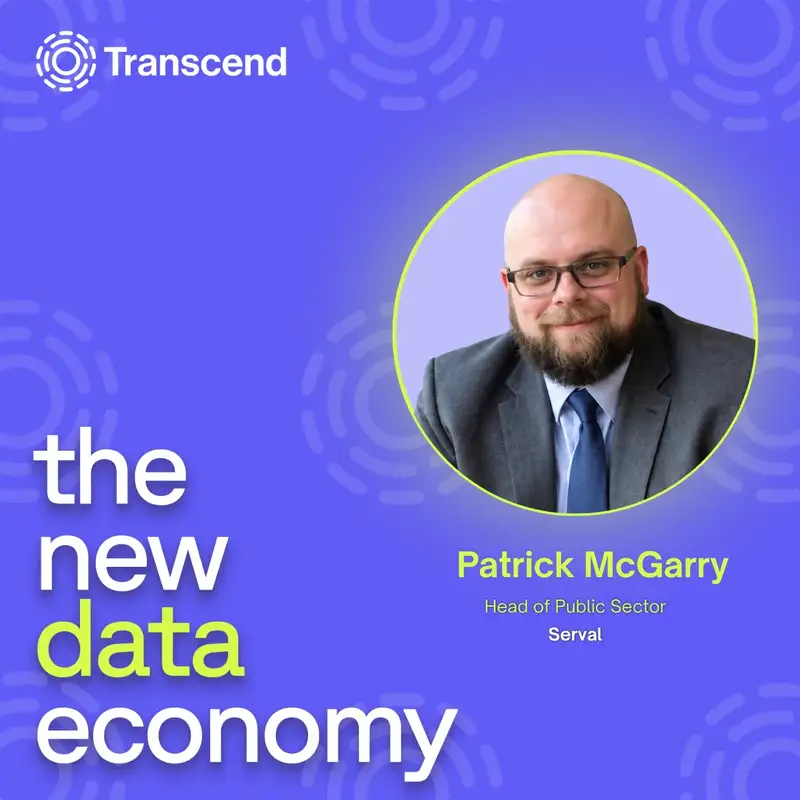
Kate Parker: We are thrilled to welcome
today's guest, an accomplished data
and AI executive, and a leader in
federal data strategy, governance,
and AI responsible adoption.
He brings eight years of experience at
Data.World, where he helped establish
and grow its federal practice across
civilian agencies, the Department of
War, and the intelligence community.
His expertise spans knowledge
graphs, semantic modeling, data
governance, interoperability, and
AI enablement, with a focus on
turning complete data ecosystems
into practical mission outcomes.
He has contributed to the data
community through leadership roles at
Data Coalition and DataPractices.org,
championing open standards and
modern approaches to data management.
He was the Federal Chief Data Officer
at ServiceNow, where he built programs
around enablement, data analytics,
and AI for regulated markets.
He is now the head of
public sector at Serval.
Patrick McGarry, welcome to the show.
Patrick McGarry: Great.
Thank you, Kate.
It's great to be here
Kate Parker: We're so
excited to chat with you.
We're gonna dig in to a lot of
interesting, uh, backstories that
you have working with the public
sector and how that has intersected
with your enterprise clients
across the ecosystem of technology.
So we're excited to dig in.
Um, let, let's get going.
I mean, I- it's interesting to me to
hear your perspective on the data and
digital transformation that we are seeing.
Tell us a little bit about how
this is impacting your industry.
Patrick McGarry: Yeah, I mean, in
enterprise software, uh, the biggest thing
for me is that AI is sort of collapsing
the distance between wanting something
automated and having something automated.
You know, this is down from
months to minutes, I like to say.
Um, you know, the systems of
record are all up for grabs, right?
Twenty years, IT service management was
sort of a ticket run queue by humans.
Uh, new customers are sort of
replacing incumbent platforms with
AI native ones, which sort of wasn't
thinkable two years ago, right?
And I think the, the biggest thing now is
the, the types of demand that we're seeing
from end users within organizations.
You know, buyers, uh, want
outcomes, uh, not just sort of
seats or, uh, or sort of insights.
I like to say that, uh, you know, insight
without action is just overhead, right?
So the questions move from, you
know, how many licenses of something
do we have to, you know, how many
tickets actually got resolved and
how much time did we get back, right?
So it's that displacement metric
that's starting to actually be more
important than just the, you know,
how much time did we spend on a thing?
Kate Parker: The insights without
outcomes is super interesting to me.
How d- how are you thinking about that
in this new data economy that we live in?
How, how are you seeing that change the
way that businesses are operating or how
they're approaching their data strategies?
Patrick McGarry: Yeah, I think
we're moving from the what
to the so what, uh, right?
So we're, we're, we're coming from this,
uh, you know, a lot of people had, uh,
Tableau or Power BI or Qlik or, like,
they had some BI tool where they were,
you know, this-- some beautiful dashboard
that they spent hours and hours creating,
uh, and then they would look at it.
And then they started realizing that
looking at it didn't really help anything.
Kate Parker: You've got
to look at it, right?
Like, you, you have to
Patrick McGarry: That's right.
You gotta do something.
You gotta do something.
It's, it's gotta actually
result in action.
And so that's why I say insights
without action is just overhead.
'Cause if you're just looking at a
pretty picture, you spent the time
to build the pretty picture, and
then you t- spent the time looking
at it, but nothing actually changed.
Uh, and I think people are starting
to realize that it's the outcomes.
And, and this is where, you know, AI
has people so excited because now,
uh, assuming they do the right things
around governance and controls and
all those things, uh, AI can actually
go take some actions, uh, and make a
human, you know, thirty, 40, 50 time,
uh, uh, percent more effective or
efficient or whatever it is, right?
Kate Parker: Right.
Yeah.
It, I, in your work with boards
of directors or executives at the
company, how has that shifted?
Like, is there that conversation
around this movement towards action?
Are you finding that to be a really
consistent conversation, or are
companies still lagging behind in
getting to the actions and the outcomes?
Patrick McGarry: you know, I mean,
boards of directors, uh, actually
have, have been a little bit ahead
of the power curve on this, I would
argue, 'cause, you know, a lot of
people got bogged down in, in the data
or, you know, the sort
of analysis paralysis.
And, but the good news is that for
a long time now, boards, uh, and
many executives, I would hope, uh,
don't buy data, and they don't care
about, like, what are the pretty
pictures, or at least they shouldn't.
Uh, they buy speed, risk
reduction, and margin.
Uh, so, so I never would lead with data
when I'm talking to boards of directors.
I always lead with sort of what
is the decision that's changing?
How is this impacting the organization?
You know, the lenses that they're
looking through, through are like
revenue, cost, ris- risk and optionality.
Uh, and so you have to, you have to
understand how to sort of translate
your world into those, into those
worldviews because they can be very
myopic and, and for good reason, right?
Kate Parker: Yeah, completely.
And, and seem… You know, a lot of our
listeners ask that question around how do
I make that connection between the data
strategy and the revenue or the
risk protection?
How have you found
that you've been able to make that
connection for people where they just
really get it, And, it feels like
it takes the conversation forward?
Patrick McGarry: Yeah, I think,
uh, a lot of times we get stuck
in the sort of immediate return.
So we'll talk about,
uh, you know, for, for AI people, it
was how many tickets or, or how many
tokens did we spend or, or how, uh,
how much adoption did we have on AI?
And that kind of missed the point.
Uh, I think you need to take the
next couple of steps down the road
for the leadership and the board.
So you have to show them not just
how much time did we save, but
it's more important to show what
did we do with that time saved.
These are the things that we could do
today that we couldn't do yesterday.
Yes, we saved all this time, but
we reallocated it into this other
work, whatever it is, that is,
you know, high return, high value,
uh, you know, types of activities.
And I think that's where they
start to get it because they see,
oh, we could do something that we
couldn't do before, and we didn't
have to hire 100 new people to do it
Kate Parker: Right.
Yeah.
And are you seeing data
is, adding value in a
specific part of the tech stack or a place
within the company first?
Patrick McGarry: Uh, I mean all
over you could certainly say this.
Um, I, I think the most value is sort of
in the middle, that, that workflow layer.
You know, again, that's
where data turns into
action, right?
So you're not seeing it
necessarily at the bottom.
We've commoditized a lot of storage
and, and again, at the top, uh, some
of the dashboard things, uh, are
interesting, but you, you really it's
that, that operational level, right?
And I think it's in many
cases still underrated, right?
Whether it's sort of your, your IT
folks who are looking at tickets and
access requests and workflow logs
and showing what really happens.
You know, that's where patterns of
automation and things where you can
get the robots to go do things and free
up human hands for higher order tasks.
Um, but, but context is
the multiplier, right?
Data is always tied to identity or
permissions or business process, you
know, and those things are worth way
more than, than data that's just sitting
in a mattress in the back, right?
Kate Parker: Yeah.
That's a really interesting framework.
I wanna spend a minute
there because I, I, I,
haven't really heard that structured
like that, and it's really interesting.
So you're saying the bottom
is where there's potential
commoditization, and at the top
is where there's a lot of insights
but very little action, and where
There's a lot of potential value
is in that middle, those workflows
where there's still a lot of value
to be extracted, but the companies
haven't necessarily gotten there yet.
Is that how you would think about
it or anything you would add to
that framework for our listeners?
'Cause I think it's a, it's
a really valuable perspective
Patrick McGarry: yeah.
I mean, I think, uh, this is the
place where we're gonna see the
most iteration over the
next year or two, right?
'Cause i- it's more than
just the workflow.
I I would say I would even take it
another few steps in saying systems
that are able to sort of capture not
just the data and not just the work
that's resulting from that data,
but how that cycle is evolving.
If you can s- really capture
that flywheel, you can start to
see how that compounds, right?
So every resolved request makes
the next automation smarter.
Like, that's the flywheel that if you
can figure out how to capture that,
for your organization, like, there are
obviously tools and things that'll help
you do that, but every organization's
gonna be a little bit differently.
But if you can figure out that
flywheel for your organization, I
think that's where we're gonna see the
most, uh, sort of exponential gains.
Kate Parker: Yeah.
That's really interesting.
I know we're gonna talk in a
little bit about some success
stories, which I'm excited to hear,
particularly in that middle section.
I'd love to ask you, you know, we use
this phrase data as currency a lot.
Does that, does that resonate
with the enterprises and
organizations that you speak to?
How are you viewing that folks are
thinking about data currently, and
how has that changed over the last
24 months from your perspective?
Patrick McGarry: Yeah.
I mean, data has always been
currency, right?
You've had a lot of sayings along, uh,
data is the new oil or, or, you know, any
one of these, uh, catchphrases happen.
I think the thing that has changed
in the last two years is the
exchange rate, right?
So AI made context-rich data far
more valuable and, and made raw
data far less valuable, right?
So two years ago, we were
looking at, uh, you know, data
was where, you know, volume, big
lakes, collect everything, right?
And the value came from analytics
and reporting sort of after the fact.
Now we're looking at
sort of context, right?
Data is tied to process and
permissions and outcomes.
So AI models are a-- becoming
a commodity, I guess.
Uh, and while your proprietary
context that goes along with it and
how it's actioned, uh, either by
those models or by your employees,
uh, sort of is not commoditized.
And I think where we're headed
next is, is action, right?
Data that can safely trigger
work with an audit trail.
Uh, so you've got agents that are
s- that spend data, uh, the way
a business spends cash, right?
Governance becoming sort of the bank.
Kate Parker: I love that.
I mean, that I'm like,
I need that on a poster.
that the exchange rate
changing really speaks to
me, and having agents be able to
act as the next frontier certainly,
like governance has to be the
structure in which that is created.
Uh, it's a really interest-
it's a very powerful analogy,
um, that you've come up with.
How do you, where do you think
companies are or enterprises
are in that evolution currently?
Are they even aware that the
exchange rate has changed?
um, I understand, you know,
Gartner recently put out, um,
some work around governance.
It's been a really
popular report for them.
Do you think that enterprises know that
the exchange rate has changed right
now, or where are they in their adoption
and understanding of this evolution?
Patrick McGarry: I think that
that differs by organization, and
I think people are all over the
board, right?
And I think it-- everyone
knows that something
has changed.
Uh, I think the savvy ones know
that, you know, public data
got cheap and private data got
expensive and sort of every
model has read the internet.
Uh, your operational history
is the one thing that a
competitor can't download, right?
Um, and, and if I can extend the
metaphor, I would also say that trust
is sort of the new interest rate, right?
Data that you can't vouch for, uh,
lineage, quality, ownership i-is sort
of discounted, uh, to zero by AI systems
and regulators and, and anyone who's
gonna have a, a stake in the game, right?
And so I think, um, people are at
different stages of the evolution
a-and it wilds-- i-it varies wildly.
Um, and it's not even big
companies are ahead and little
companies are behind either.
It's like y-you can often see the
innovators, and they, they become
very clear in terms of what are their
outcomes, you know, even looking
inside of the public sector, right?
Uh, there are folks that are way behind.
I won't name them, I
won't shame them here.
But, uh, there, there are people
that, uh, perhaps surprisingly to
some, uh, are way out ahead, uh, in
just in terms of what they're doing.
You know, Department of Commerce is
doing some really cool stuff around
how do we make our data authoritative
to the models as opposed to how
can we use models on our data.
Uh, so they're sort of thinking
big picture and trying to be
more of authoritative source.
Uh, if you look at like some of the,
the semantic modeling and, and sort
of graph structures that the SEC is
using in the sort of regulatory space,
very cool work that they're doing.
So like, there are definitely
people that are, are sort of
the haves versus the have-nots.
Um, but I think, you know, the
tools are all there for the taking
Kate Parker: Can you identify
the attributes of the enterprises
that you feel are farther ahead?
Is there consistency in what you're
seeing and how they show up, how
they think about the problem-solving?
'Cause the example you just gave is a
really interesting one, and I'm, I'm
curious if our listeners would be able
to understand what attributes should
I be looking for in my enterprise to
know if we are on that innovation curve
Patrick McGarry: I think the,
the biggest thing is the types of
questions that you're able to ask
or, or that you are actively asking.
Uh, if they are heavily nuanced, uh,
and, and they can be answered as nuanced
questions, uh, then you're probably
pretty, pretty far down the road.
If you're still asking relatively
simplistic or, or monolithic
questions, um, you may have
some work to do, uh, right?
But, you know, I think the folks
that are moving into this next era
are gonna start thinking about,
like, what are the data contracts
between systems and agents look like?
Uh, if you look to China, they've
actually started giving, uh, influencer
agent bots their own bank accounts
and starting to treat them as, like,
almost human beings or individuals.
Like, think there is going to be a
whole new, you know, you say the data
economy, I think this data economy
is actually going to become a, a very
much of an economy in and of itself.
And so the boards that are start asking
for the data balance sheet, uh, I, I think
are gonna be the, the indicators that
you have sort of arrived at the next tier
Kate Parker: Yeah.
That's super interesting.
What-- In your perspective,
what is that data
balance sheet for most companies
today versus what it should
look like in a year or so?
Patrick McGarry: I mean,
that's hard to say, right?
A lot of it is gonna be contextually
specific to your industry and your company
and your business and your outcomes
and things like that.
But, you know, it's obviously
gonna be like, what are the assets?
And, and more importantly perhaps
than the individual assets
themselves is how do they connect?
How do they relate, right?
And that's where you start getting to
that, that knowledge graph thinking.
And, you know, if you haven't, uh,
found a book or, or read a book on what
are knowledge graphs and, and what is
the semantic web, like go find one.
Like there's a million of them.
Uh, Tim Berners-Lee introduced the
concept 20-plus years ago when he said
like, "Hey, the internet is essentially
a series of links between documents."
Like that's ultimately
what the internet was.
Uh, and the, the next evolution in this
technological, technological approach is
gonna be doing the same thing for data.
Um, and you know, the-- we have not
really met that promise yet, but
we're, we're getting closer today
than we have been in the past.
So, uh, I think those are the
kinds of things you're gonna
have to start looking for.
Kate Parker: That's so great.
Um, I know
that you
have worked in some really
interesting case studies
that our audience would love
to learn a bit more about.
I'd love to ask you about two because,
um, I think they show a really interesting
range but with the same core problem.
You had mentioned that you worked
with a customer, one of the largest
advertising conglomerates on the,
on the planet that has 300 different
business units, and really having
to work through how you unify their
data approach into a single model.
Tell us a little bit about that problem
and what it was seeking to solve.
I think it would be really
fascinating for us to hear.
Patrick McGarry: Yeah, I mean, when…
Anytime you look at these roll-up
businesses or very large organizations
that have been around for a little while,
you've got a lot of stovepipes, right?
You've got a lot of these little
micro insular communities that
exist underneath the large umbrella.
And, uh, without into, getting into too
s- many specifics about their, their
case, I'll tell you that, like, you
know, 300 business units means you have
300 different data models, and you have
different data stacks and different
processes and all of these things.
And so unifying that so that you can
share data so that it is apples to apples
between these business units, and you
can learn from each other and those
sorts of things, uh, you really had to
sort of look at how do we unify this?
And this goes back to that graph thinking
that I was just talking about earlier.
And, uh, to put a sort of hypothetical
use case in front of it, it was, you
know, if I'm an advertiser, uh, I can
know things about individuals, right?
John Smith, he lives in Atlanta, Georgia.
He's got a wife, three kids, and
a dog, uh, uh, you know, a picket
fence on Main Street, whatever.
Um, but we know that he made 10 online
purchases last year, and we know exactly
how he arrived at each of them, right?
And now the trick is, okay, show me
100,000 people that look just like
John Smith, 'cause I know exactly what
they're gonna wanna buy and how they're
gonna make those decisions, and I can
feed them the advertising that will
take them through those decisions in
a way that I want the outcome to be.
Um, so it's, it's being able to take these
disparate, sort of mismatched things.
Uh, and the answer isn't to throw it all
into a single data lake, 'cause you're
gonna introduce all kinds of problems.
But how do we create sort of this
connective tissue, this translation
layer across those 300 businesses so
that they can share data and context and
understanding, uh, and, and make sort of
those bidirectional conversations happen?
Uh, and so that was the coolest
thing, uh, to see, was to, to look
at how that evolved, uh, and how that
ultimately came together to be sort
of a single cohesive, uh, outcome.
Kate Parker: Yeah.
and as you g- as you were going
through that process, I have
to imagine it was difficult
probably just even in and of itself to,
get all of the business units aligned.
Did you find that there were any tech
stack specific challenges, or was it
mainly on the process and the people side
to get folks onto that unified model?
Patrick McGarry: Yeah, I mean, a
little bit of both, uh, for sure.
Uh, I mean, the, the thing that
I spent the most time writing my
book about was just looking at,
uh, organizational design, right?
And I think, you know, especially when
you start looking at AI, but even when
you're just looking at, at the data
systems and the modeling and those
sorts of things, uh, you know, AI, uh,
isn't gonna be this magic silver bullet.
Neither will, you know, a graph or
a technology purchase or anything.
You're not gonna have that silver bullet.
Those, those just don't exist.
Um, but, you know, while AI may not
modernize you, it's certainly going to
help you show whether your organization
was ready to be modernized, right?
And I think that's, that's the big
thing, is so much of this stuff, it
has to involve the, the people, the
process, the culture, uh, has to go
along with the technological change.
There's, there's no software on
the planet that you're gonna deploy
tomorrow that will change the people,
uh, and how they want to do business.
So it, it has to be a blend
Kate Parker: Whether or not a
company is ready to modernize feels
like such an important question.
Um, that is so well said.
You have a really interesting vantage
point of looking at not just the
private sector, but obviously the public
sector as well based on your career.
Talk to us a little bit about the work
that you did with the Army, particularly
in the biodefense field, and where You
saw similarities and differences in terms
of creating that unification at scale.
Patrick McGarry: Yeah, I mean, that
was an, a really interesting plan.
It started with the, the
defel- Defense Health Agency.
Um, and they started-- You
know, there's a big push.
Um, you know, Bob Kadlec, uh, and
his, uh, work with the biodefense
across the department, they've
been doing some really cool things.
Um, we were one small part of, of
that, which was exploring, you know,
how do we take, uh, defense, health,
and intelligence data and synthesize
that together with open data, what they
call open source intelligence or OSINT,
which is essentially what's available
on the open internet that we can get
to and, and ingest and make sense of.
So how do we bring all of these
different types of data and stakeholders
together, uh, to-- for the purposes
of biodefense or what they might call
biosurveillance, which is really just
saying, how do we find the next COVID
faster and do something about it quicker?
Uh, or how do we find a, a bad a-- uh,
a bad actor or a nation state, you know,
rogue nation state that's gonna try and
introduce a, uh, a bioagent of some sort?
Uh, and then how do we do
stuff about that, right?
And so if you look at, you know,
these are very monolithic, uh, types
of, uh, of, of organizations, right?
The intelligence community, the
defense health organization, the
individual combatant commands,
uh, across the, the globe, uh, you
know, and then open source data.
Like, bringing all of those things
together, it's, it was-- it wasn't
even a, a square peg in a round hole.
It was, you know, a, a
basketball in a submarine.
Like, there just was no, no good way
to bring these things together when,
when the, when the Defense Department
started trying to do this stuff.
And you can go back two years ago
and see the genesis of this stuff,
where the intelligence community
really spent a lot of time and effort
talking about interoperability of
data and interoperability of systems,
and they knew that it was a thing
that, that was very, very important.
Um, and, and I think that a lot of those
lessons learned were sort of injected into
what we were trying to do in this space.
And, you know, there was
a lot of really cool work.
Uh, it is ongoing today.
Uh, I think it's very exciting to see
some of what, you know, people think
about the government, and they think
about, oh, they're, you know, twenty
years behind, uh, the technology.
And it's just not the case anymore.
Like, the, the Defense Department in
particular is really driving forward.
You know, the days of DARPA-led innovation
are pretty squarely in our rearview.
But the partnership between industry and
the Defense Department, uh, is starting
to, to net some very cool outcomes
Kate Parker: It's so true.
I, I think we often think
about the public sector as
being a step behind.
And, you know, even myself
having, you know, worked in the public
sector, y- you can sort of carry that
forward and that not being necessarily
true anymore, and that it is a place
of innovation and partnership that can
offer some really important lessons to
companies that want to be innovators,
and particularly just at the scale
and size in which they operate.
What are some lessons learned that
you think folks can take from what
you have seen in the public sector
and some of these huge monolithic, you
know, organizations that are trying
to be modern with their data usage?
Patrick McGarry: Yeah, I mean, there's,
there's great evidence all over the place.
And I would say the
very first thing you have to do
is, is sort of divorce politics,
the, the political view from
the, the actual, you know, day to day.
Uh, we've become so polarized as a,
as a country, you know, we're just,
you know, we're, we're willing to just
think that, uh, you know, people are
doing the wrong thing for whatever
reason or assumption that we may have.
But once you get, like sort of scratch
the thin veneer of politics and you
actually get into the, the actual
dedicated public servants, that is the
thing that has amazed me every day, uh,
of working with the public sector is there
are dedicated public servants who just
care deeply about the mission outcome.
Uh, and they are doing the work.
Uh, and, you know, politics aside, they,
they care about what they're doing.
Uh, and I think that that is
very important and it shows.
Uh, and I think that's one of the first
things, first lessons that I would say
is like, as an organization, you have to
collectively build a culture of caring.
Like you just have to be passionate
about the mission that you're on.
And, and as soon as it starts
to stagnate or, you know, people
sort of have their eyes glazed
over, like you're, you've lost.
Uh, and so you have to find a
way to keep that invigorated.
Um, and then, you know, sort of looking
at problems of scale, um, it- it's really
cool to look at sort of how, uh, some
of these very large scale organizations,
you know, even like the, the VA, right?
Six hundred thousand employees, like
forget about the veterans, uh, which
is a whole other, you know, community
that they have to serve, which is even
larger, but like six hundred thousand
employees, any enterprise system, uh,
is gonna have to be pretty robust.
So like looking at how they
approach and handle scale across
the government, uh, are some very
cool lessons that you can learn.
Kate Parker: So many great
parallels, um, for our audience,
particularly for our Fortune 500
companies that are thinking at scale,
how do we keep people mission aligned
and focused on the work at hand?
And then how do we actually
put that into action?
How do we make sure that that's possible?
So I- it's so great to hear those.
I'd love to, you know, let's
flip to the other side.
Let's flip to the, the
more challenging side.
What are some of the bigger data
challenges that you think still
exist, particularly as it relates to
companies that want to be modern in
AI initiatives, uh, but perhaps are
facing, you know, gaps and blockers?
It feels like there's a new stat every
week in terms of how many blockers exist,
how many folks feel that they are held
back from realizing, uh, the value of AI.
What do you think the data challenges
are that are stopping the ambition
and the execution that companies want?
Patrick McGarry: I'm gonna,
I'm gonna slight-- I'm gonna
answer the question that you
didn't ask.
Uh, I'm, I'm gonna pivot you a
little bit, which… A-and I think,
uh, I'm, I'm gonna
specifically focus on AI
just for a minute because I think the, the
differences here are a
little bit more stark.
Uh, I, I think the hardest
AI problems aren't technical.
I'm gonna go back to the people, right?
They're organizational.
We're putting twenty twenty-six
technology into org charts that were
designed for nineteen ninety, right?
And org charts follow functions,
whereas AI follows workflows.
You know, a single automated request can
cross IT, HR, security, finance, right?
Nobody owns the whole flow, so
nobody owns the automation, right?
And, and these handoffs, the more
handoffs that you've, you've seen
historically, the slower something has
gone or the more likely it is to break.
It becomes brittle when you start
crossing these boundaries, uh, because
the decision rights are unclear, right?
And, and that holds true for AI right now.
When can an agent act?
Who approved it?
You know, organizations built on sort
of hierarchical approval chains really
stall, where the adaptive ones are pushing
decisions to where the information is.
Um, and so that's your data hook, right?
Trying to push decisions to the
data as opposed to pulling data
into the decision-making process.
Uh, and so I think roles are
going to have to be defined by
tasks and not outcomes, right?
So tasks get automated, task-based roles
feel threatened, uh, whereas outcome-based
roles sort of absorb that change
Kate Parker: The org chart of the
future feels really
interesting to think about.
Uh, we f- we feel this as well,
e- even on the governance side,
which as we talked about earlier, is
foundational table stakes for a lot
of this da- data value realization.
You know, where does it stop?
Where does it start?
Is it the CISO?
Is it the CIO?
Is it HR? Is it legal?
Um, and folks have a bit of it all,
um, but it certainly needs to cross
over a lot of departments in order for
there to be true value realization.
Um, as you think about the org
chart of the future, do you already
know where things move, or do you
think it's an ongoing conversation
of how th- how it gets realigned
to be more in service of value?
Patrick McGarry: Yeah.
I mean, I think it's
kind of a moving target.
Like, I, I have some
opinions, um, but even
my own opinions tend
to, tend to shift, uh, day to day,
week to week.
Um, but I think the biggest thing
that we're gonna have to focus
on is, is sort of trust and culture,
uh, or trust as culture maybe.
Uh, just because, you know, people
adopt what they understand and help
shape, uh, and they're gonna be
resistant to things that feel like
they don't fit into their model or
their worldview or, or whatever it is.
And so I think it, it's gonna be hard
because we're gonna have to meet people
where we are… where, where they are,
but then we're also gonna have to help,
you know, gently push them forward
into the place where they need to be.
Uh, a- and sometimes, uh, that may involve
some amount of, uh, kicking and screaming.
Kate Parker: Do you think that
many, if any companies right now are
thinking about shifting their org
charts for AI initiatives and value
realization of, data?
Patrick McGarry: Some are and some aren't,
and I would say this is where the little
guys are really beating the big guys.
Um, and, and you can even look
at the differences between
my last two employers, right?
Like, ServiceNow has articulated,
"Oh, we're not gonna need
to hire, uh, early-stage
employees or junior employees."
and and then of
course, the natural questions
are, okay, how do you build, uh,
mid-stage or senior people if you've
never hired the junior people?
Um, a- and I think the, the other side
of that coin is sort of the, the thing
that Serval has stated very publicly,
which is, like, we're creating a different
kind of entry-level employee, right?
Whether it's a, an automation engineer
or, like, however you think about
it, the job roles are, you know,
by very nature, uh, going to shift.
I mean, every tectonic shift in technology
from the, uh, you know, phasing out of
printing presses to the, you know, the
advent of the internet to the advent of
the smartphone, like, any time you've
had these sorts of things, you've seen
these large shakeups in, like, what are
the job roles that people are hiring
for, and how do you get in and evolve?
Um, so I think we're gonna
see the same thing now.
It's just we're, we're operating
on compressed timescales, uh, in,
in a way that we never have before.
Like, they have very, very compressed,
uh, how we're handling these changes.
Kate Parker: So
it'll be gr- it'll be really
interesting to see how that changes.
I agree with you on the entry-level
funnel needing to shift.
It also feels like there needs to be
a conversation of what at the most
senior levels, like what do these
organizations look like in a, in a
time period where the outcomes that
the organization might drive are, are
more interdependent than ever with the
organizations that sit next to them.
What excites you most about
the future of the data economy?
Um, you're obviously sitting, you
know, right, you've got a front row
seat to the future at Servo, but
what are you seeing that makes you
excited about where we are headed?
Patrick McGarry: Yeah.
I mean, I think the biggest
stuff-- I mean, obviously I'm
very sort of myopically focused
on automation at the moment.
Um, but, but obviously it's
personal point of view, right?
I think that's where some really exciting
things are happening.
It's how do we
take something that is not necessarily
deterministic, you know, these general--
generative AI tools, LLMs, whatever, uh,
that can be very sort of loosey-goosey in
terms of, like, how do I interpret this
thing, and then what do I do with it?
How do we take that sort of mechanic,
which can be very powerful, um,
and how do we combine that with
things that are very deterministic
and auditable and transparent?
Uh, and I think that's the thing that
has me the most excited right now, is
like looking at, uh, blending those
two worlds together so that you have
AI, you can create some amount of,
uh, uh, a, you know, shadow person
or maybe three hundred shadow persons
sitting next to you every day doing
things that you don't wanna do, right?
Uh, and, and but putting them into
a framework where that becomes
deterministic and predictable and
auditable and all of those things, right?
Um, and so, you know, the-- this goes
back to, again, the, the bottleneck
is in the AI adoption isn't the
model, it's the operating model.
Uh, but, but, you know, I think this
is the exciting part of this, which
was like, how are we creating something
that our, you know, new folks that were
raised on, on the sort of different
technologies, uh, that, that wanna get
excited about the next cutting edge thing?
How do we blend that together with,
uh, you know, your thirty-year
veteran CISO who has to look at,
uh, you know, sitting in front of a
board of directors or shareholders
or Congress, uh, and explaining
how decisions were reached, right?
Uh, so to me, that's
the most exciting thing.
Kate Parker: That's great.
you had mentioned, um, a
reading list earlier that our
audience should think about.
What, what's on your reading list right
now that you think will help set
folks up for understanding the future?
Patrick McGarry: Yeah.
I mean, the one that I just finished
reading that I think is the most
exciting, um, was by my former CEO.
Uh, it's called Love
Conquers Fear: Humanity,
AI, and the Age of Abundance for All.
Uh, very super cool book.
Uh, I would encourage people to read it.
You know, in, in this sort of era of
exponentially evolving AI, uh, the most
important code we can rewrite is our own.
I think that was how he opened
the, the, the book, right?
Uh, and I think it's, it's really
looking at some of these societal
problems combined with technology, and I
thought it was a, a very cool take, uh,
that wasn't just a pure business book.
It wasn't a pure technology book.
It, it was a lot of
humanity infused in it.
And so I, I really found a
lot of excitement out of it
Kate Parker: That's great.
Say, say the title one more time.
I want to make sure everyone gets it
Patrick McGarry: Yeah.
It's, uh, Love Conquers Fear is the
big title, uh, but Humanity, AI,
and the Age of Abundance for All
Kate Parker: I love that.
Love conquers fear.
Okay, great.
We're gonna have to pick that up.
I, um, I'd love to hear a little bit
about what you were like in the early
'90… I mean, you worked in the
early days of the internet,
right?
So we've talked a lot about
working on problems at scale.
We've talked a lot about the future of
where we're going, but take, take us back.
You obviously spent time at
Slashdot in the early days.
What was it like back then when no one
had done it before, and what are you
seeing now that reminds you of those early
'90s moments?
Patrick McGarry: definitely
showing my age here.
Uh, you know, I've got all the gray in the
beard, and I, I tell my kids that,
uh, you know, all of this was earned.
Uh, you know, and it's funny, coming
back to a, a Silicon Valley startup, I'm
definitely now
the old man.
Uh, but, but it was, it was fun, right?
'Cause y- it was Wild West-y, uh, in,
in much the same way I'm sure that,
that folks coming up through the s-
beginning and mid-level career are
gonna look back and say, you know,
"This AI time was super Wild West-y."
But, you know, operating on
a, a, a website essentially
like Slashdot, uh, was fun.
It was, it was news for
nerds, stuff that mattered.
Uh, and so we had such a large technology
audience, uh, that it was considered
a badge of honor in the, in the '90s
when, like, you got Slashdotted, which
was essentially we would link to your
website, and we had so many people that
would visit your website, it would,
it would knock you out of commission.
It would melt your web
servers, whatever it was.
Um, so it was, it was a fun time 'cause
we had questions of scale that we were
asking of the technology at the time
that really had never been asked before.
Uh, and so it was some very cool things
to, to be able to play along with.
And, and as I mentioned, you know, uh,
the early days of internet advertising
and, and solving those types of problems.
Uh, so my apology to the world
for where internet ads have,
have got- gotten us today.
Uh, but the early days of Dart for
Publishers and what became Google
AdWords and things like that, we
were definitely playing a- around
with a lot of that early stuff.
And so it was, it was fun, and I think
it has informed a lot of sort of how I
think about technology and how I think
about scale, uh, today, which is still
helpful, uh, in, in approaching these
problems that we're, we're facing, so.
Kate Parker: That's so great.
I understand that when you're not
in front of a computer,
you are under the water.
You're, uh, you're in, the water.
You are, you are scuba diving.
Tell us a little bit about that passion.
Um, where did that come from?
D- does it relate at all to what
you're seeing, um, in your work?
Patrick McGarry: uh, I mean,
not really, but I think it's a
necessary evil for me, right?
I I think I… Having to come up with
new and creative ways to unplug, uh,
you know, the, the more time I spend
really deep in the weeds of technology,
I have to also, uh, go deep in actual
weeds and get away from technology.
Kate Parker: Literally.
Like d- yes,
it's a very, yes, it's a
very literal interpretation
Patrick McGarry: Yeah.
So no, it's, it's fun.
I love it.
It gives me a, a reason to
travel all over the world.
Uh, my wife and I scuba dive in,
you know, Australia on the Great
Barrier Reef, in the Caribbean,
places like, you know, Bonaire and,
uh, Mexico and, and out in Hawaii.
Uh, you know, so yeah,
it's, it's my happy place.
Uh, all the rest of the world just kind
of fades away and, and you can just kind
of exist, uh, quietly, which is nice
Kate Parker: Amazing.
My understanding of scuba
diving is that the preparation
and, communication also are
quite important to just doing the
sport safely.
Do you find that there's overlap
with how you approach handling your
work or communicating with, you know,
and it l- you know, the Army, the
Department of Like, these large scale
Are you taking anything of that
with you as you, um, head into scuba
diving?
Patrick McGarry: I mean, it
may just be self-selection.
uh, y- you know, everything
from being very logical.
uh, I… was, You know, an ultra
nerd, loved math and physics in, in
s- uh, school when I was younger.
Went into the Navy, uh,
got the military flavor.
So like I, I think maybe I'm just sort of
self-selecting into these very, uh, you
know, rigid planning, communication, and
execution types of, uh, types of things.
But, uh, you know, I… Who knows?
You know, if if
one, one begets the other.
Kate Parker: Yeah.
It's so fun.
Um, where can
people connect with you if they wanna
find out more about you, about your
book, um, hear your thought leadership?
Where's the best place
for people to find you?
Patrick McGarry: Uh, I… mean,
I'm pretty active on LinkedIn.
Um, I will see a LinkedIn message.
I'm, I'm usually pretty,
pretty happy there.
Uh, if… As long as folks aren't
trying to sell me something, uh, I usually
have a pretty negative reaction to that.
Uh, but, you, know, uh, I
have my own vanity domain,
mcgarycdo.com.
If, uh, people have, you know, media
inquiries or wanna find a link to the
book or, or, or whatever, um, like, those
are probably the two easiest places.
But I also spend a lot of time going to
conferences and speaking and whatnot.
So, you know, odds are, if you're
gonna be at a Gartner event or a, a DOD
event, or if you're gonna show up to
the Carahsoft offices in DC, uh, you'll
you'll probably find me at some point.
Kate Parker: They'll see you.
If they're, if they're a Gartner,
they're gonna see you, right?
I love that.
That's awesome.
Um, well, we know a lot of our
audience spends time looking
for thought leadership,
connecting with peers,
so I'm sure you'll get
a chance to cross paths with them.
I want to thank you so much,
Patrick, for joining the pod today
and for this great conversation.
I feel like we learned so
much, uh, comparing the public
sector and the private sector.
I, I find that that analogy that you
came up with is really gonna stick
with me, um, in terms of creating
the, you know, the economy and
applying it to data, the interest
rates and the exchange rates changing.
Um, so I think our audience had
just so m- so many good nuggets
for our audience to listen to.
So thank you for joining us.
Um, thank you so much to our listeners.
I hope if you learned something
today or laughed, you will tell
someone about this podcast.
Patrick, thank you again
for joining us on the pod.
Patrick McGarry: Awesome.
Thanks for having me, Cato.
It's been a pleasure
Kate Parker: This has been another
exciting episode of The New Data
Economy, and we will see you all next
time.
Thank
you