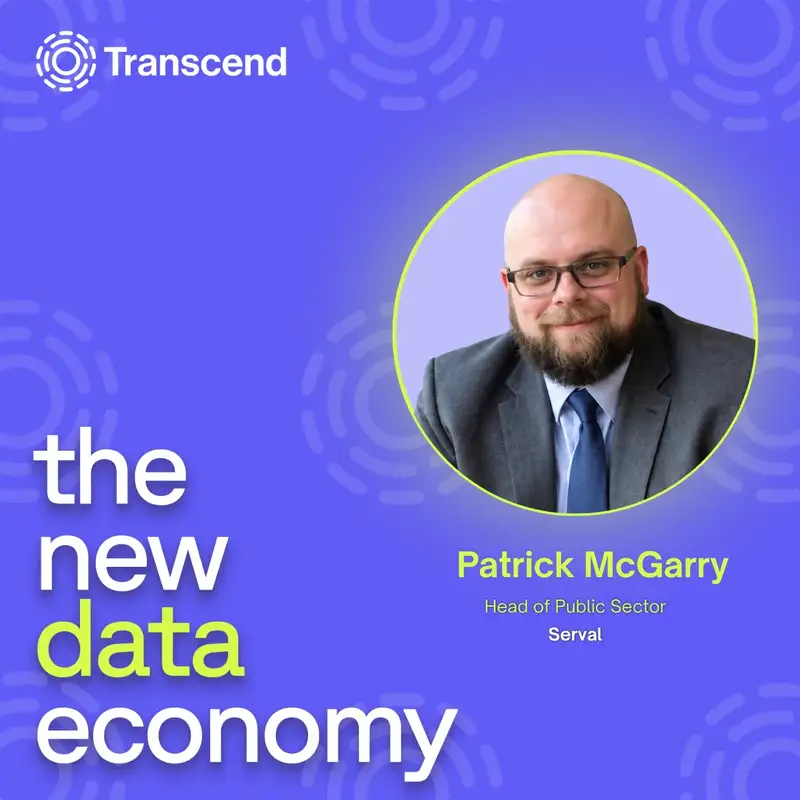
Data has always been currency, but AI has changed what it is worth. Patrick McGarry, Head of Public Sector at Serval and former Federal Chief Data Officer at ServiceNow, explains how raw data lost value while context rich data gained it. He walks through why the dashboard era is giving way to an era of action, and why trust, lineage and governance now work like interest rates and banks. Along the way, he shares how he talks to boards about revenue, cost, risk and optionality instead of data.
Patrick also draws on his experience unifying 300 business units at one of the largest advertising conglomerates, and on his biodefense work with the Army and Defense Health Agency. He makes the case that the hardest AI problems are organizational rather than technical, since org charts follow functions while AI follows workflows. He closes with what excites him most about blending generative AI with deterministic, auditable frameworks, plus a reading recommendation and a few stories from his days at Slashdot and under the water.
Takeaways:
- Insight without action is overhead. A beautiful dashboard that nobody acts on changes nothing, so shift the questions from “how much time did we spend” to “how many tickets were resolved and how much time did we get back.”
- The exchange rate on data has changed. AI models are becoming a commodity, while context rich data tied to process, permissions and outcomes keeps its value. Raw volume is worth far less than it was two years ago.
- Public data got cheap and private data got expensive. Your operational history is the one thing a competitor cannot download, and data you cannot vouch for in terms of lineage, quality and ownership gets discounted to zero.
- Speak the board’s language. Lead with the decision that is changing and frame it through revenue, cost, risk and optionality. Show what the organization did with the time it saved, not just how much it saved.
- Look to the middle of the stack. The workflow layer is where data turns into action and is still underrated. Capture the flywheel so every resolved request makes the next automation smarter.
- The hardest AI problems are organizational. Org charts follow functions while AI follows workflows, so nobody owns the whole automated flow. Push decisions to where the data lives instead of pulling data into a slow approval chain.
- Pair flexible AI with deterministic structure. Generative tools are powerful but loose, so wrap them in frameworks that are predictable and auditable. The bottleneck in AI adoption is the operating model, not the model.
Quote of the Show:
- “Public data got cheap and private data got expensive. Your operational history is the one thing that a competitor can’t download.” Patrick McGarry
Links:
- LinkedIn: https://www.linkedin.com/in/patrickmcgarry/
- Website: https://www.serval.com/?utm_medium=social&utm_source=linkedin
- Book Link: https://www.amazon.com/dp/B0GZLRLHQM?lv=shuf&channelId=500&plpRedirect=mhFallback
Ways to Tune In:
- The New Data Economy Website: https://newdataeconomy.com/
- Spotify: https://open.spotify.com/show/2SMgCQX3xDGAt45nVXLbJl
- Apple Podcasts: https://podcasts.apple.com/us/podcast/the-new-data-economy/id6813179089
- Amazon Music: https://music.amazon.com/podcasts/d5aca841-e469-450d-829f-1b4c8388a764
- iHeart Radio: https://iheart.com/podcast/345586235/
- YouTube: https://youtube.com/playlist?list=PLKEpXLeSlqYM&si=7O2mjjP5IWM8D6ib