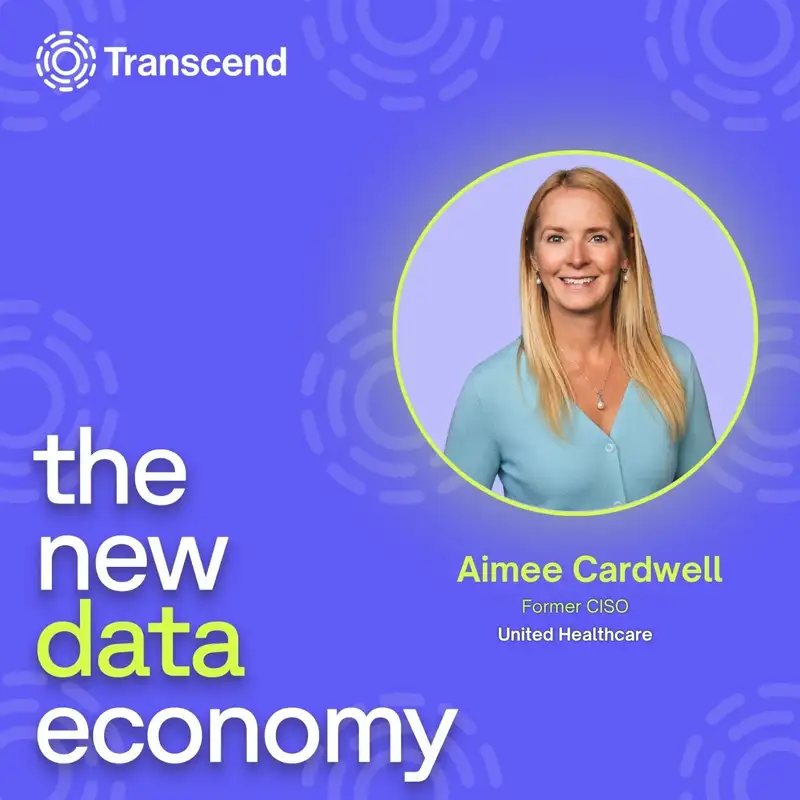
Aimee Cardwell - TNDE
===
[00:00:00]
kate-parker_2_07-16-2026_100754: All right. We're thrilled to welcome our guest today on the show, The New Data Economy. Um, we have an awesome guest for you all, um, all our listeners. Amy Cardwell is joining us. She is a dynamic executive, a trusted board advisor, a board member herself, and a recognized cybersecurity leader. And she's really known for working in complex [00:01:00] organizations in regulated industries.
And so we're gonna unpack what the new data economy looks like in the regulated industry specifically. So welcome, Amy. We're thrilled to have you here. I know you've been a chief information security officer at UnitedHealth Group. You've been a CIO. You've worked at American Express. You've worked across healthcare, financial services.
You have been named TAG Cyber's 50 to Watch. You were a World 50 Impact Award for Courage winner. You were named a top 100 executive women in tech to watch, and you serve on the board of WEX, a publicly traded financial services company. Thank you for joining us. Thank you for being on The New Data Economy pod.
We're just so thrilled to have you here
aimee-cardwell_2_07-16-2026_130754: Thank you. That, uh, that introduction is a little embarrassing.
kate-parker_2_07-16-2026_100754: Well, all true, which is good, which is why we're so thrilled to unpack this. There's so much happening across the financial sector, across healthcare, and you've had a front row seat to seeing it all. Um, so I think [00:02:00] our listeners are really gonna enjoy hearing what you think is happening as we go through this large transformation.
So I think it'll be exciting
aimee-cardwell_2_07-16-2026_130754: I'm super happy to be here. Thanks for having me
kate-parker_2_07-16-2026_100754: Awesome. Before we kick off, when you think about the regulated industry and when you think about what's happening with data today, how the value proposition has changed, like what's the first thing you just want our listeners to know of where we're gonna take the conversation and where, what you think is happening in industries?
aimee-cardwell_2_07-16-2026_130754: Yeah, I think data used to be, um, kind of like a, uh, an after or byproduct of the other work we were doing. It's like, yeah, yeah, yeah, we're serving our customers, and also there's this data over here, uh, that is sort of the byproduct of serving our customers. But these days, I think that increasingly to be competitive, you need to treat your data as a sort of a, an asset as opposed to just a thing that's being stored. And in large healthcare companies, uh, just as an example, that's really hard to do because the data may be spread in hundreds of data [00:03:00] stores. Um, and if you're very acquisitive, as, uh, happens sometimes in the healthcare space particularly, you get even more of those. So no matter how quickly you would try to clean it up and centralize your data into these really, you know, governed rights aware, ready assets, it still becomes complicated because you keep throwing in more and more and more companies, which means that your data stores are proliferating again. So it's hard to make your data architecture strategic when your, when your sort of enterprise, uh, in- infrastructure is such a mess
kate-parker_2_07-16-2026_100754: I love that. I can't wait to unpack that further because I know you're gonna help tell us some stories about how you're seeing executives show up in different ways with different skill sets in order to navigate those different data pieces. But maybe just take us back, like take us back to a little bit of the day in life when you were in healthcare versus financial services.
What feels different from then to now, um, in terms of how, how folks are using data? To your point, like it's more value-driven, it's more front [00:04:00] and center.
aimee-cardwell_2_07-16-2026_130754: Yeah, I mean, if you look at, um, I'll just use American Express because it's such a well-known company, and then I'll contrast that a little bit. American Express has always had to pay attention to your data as an individual because unlike other credit card products, there is no limit on lots of the-- of their lines of credit. So they need to be looking carefully at your buying processes. What are you buying? Where are you buying it? Does this fit your model or your profile? And so when you look at that company, you go, "Oh, okay. They've been thinking about that sort of data as an asset, as a primary asset for a long time." But in the healthcare space, we have another interesting set of problems because large conglomerated healthcare companies have of all the way down at the bottom where you're like, okay, South Shore Podiatry or your chiropractic or whatever, they've got your data, but more and more they're owned by a conglomerate, and [00:05:00] so they keep picking up these mo-mom-and-pop provider shops all over the country. And the data is stored in a, uh, in a lot of different places in a lot of different ways. So you've got billing systems, and they're probably, um, as the third-party billing system. You've got the care data, and you've got some direct-to-consumer work that's starting to happen more frequently now. And those pieces of data are not interchangeable.
You can't take care data and reuse it for direct-to-consumer marketing. But you can take care data and use it for developing better practices for delivering healthcare or developing medicines to treat conditions. So there are a lot of different rules and types of data, and we have to think hard about which data do we wanna use for which purpose, and if we're trying to develop something interesting like a direct-to-consumer model, how do we make sure that that data is properly consented, uh, and how do we-- If it's not, how do we [00:06:00] create consent events that enable us to get more consented data to make us more successful?
kate-parker_2_07-16-2026_100754: It's so true. Yeah, Luke, I'd love to have you come into this 'cause th- when I think about the value proposition, it's all, can I use this data, right? Like, that's what folks are asking within their corporations, and Amy, you've just laid out a perfect example of when they don't know the answer. They're trying to use it for a new way.
Luke, I'd love your, your input on this
luke-arno_2_07-16-2026_100753: Yeah, I think w- the, the point of curiosity for me is you pointed to the direct-to-consumer shift in healthcare and payers and providers building consumer-grade digital front doors for the experiences, but you talked about the disparity of the data and the compounding effect of compliance. When you talk to CIOs and you, you learn about the timelines that they have today to launch direct-to-consumer initiatives or maximize customer data with compliance,
aimee-cardwell_2_07-16-2026_130754: Yeah
luke-arno_2_07-16-2026_100753: do you begin to think about solving those problems?
How many people are involved and across what different parts of your team?
aimee-cardwell_2_07-16-2026_130754: Gosh, it depends a lot on [00:07:00] the size of the company. The smaller the company, the easier it is to get done 'cause there's less data to deal with, and frankly, fewer cooks in the kitchen, as you so rightly pointed out. In a very large company, there could be dozens or even a hundred people involved in trying to get something like that done. Um, many companies are, um, limiting the amount of customer data that they use for a direct-to-consumer pitch because they're so afraid, and they don't understand how to get consent on a large percentage of their data, so they use a really small percentage, you know, ten percent of their data, and they're trying to build a business case based on that really small amount of data. And that's why one of the things I've been talking to people about is how to create consent events. I-I'll give you an example. So let's use GLP drugs, right? I think one in ten Americans or one in eight Americans either have used or are using a GLP. And you know that that space is evolving really quickly.
New drugs, new formulations, even now, [00:08:00] uh, oral formulations instead of those that need to be given by an injection. if you're the manufacturer of one of those companies, what you really want is to create a direct-to-consumer understanding, 'cause generally, you're not the prescriber. The prescriber is a provider, and you-- it's difficult for you to make a relationship. But you're hard at work on an oral version, and what you really want to be able to do is sell that oral version to the people who are already taking the injection version 'cause that's your target market, right? So how do you create consent events with those folks? Well, you've all seen it. Many, uh, many drug manufacturers are creating coupon programs or discount programs that are designed...
The consumer is like, "Well, sure, I want fifty dollars off of my regular prescription." But what's happening is that's creating a direct relationship between the drug manufacturer and the person who's taking the drug Another way to think about this, and let's just stay on GLPs, right? Is if you were [00:09:00] using a GLP, Luke, I might as the-- You know, you've taken me up on my coupon deal.
Great. So now we have a direct, a direct relationship. I might say, "Are you okay if I remind you every week when it's time for you to take your injection?" That's a consent event. You go, "Yeah, sure. Sometimes I forget." So now I have a right to email you or text you, whatever we've agreed to every week. So now when I develop my oral version or my cheaper version or my version that works ten times better or doesn't have any side effects or whatever the next versions are gonna be, I can reach out directly to you through that mechanism that we've already created. And that, for me, is how, you know, when we talk about the new data economy and data being oil is sort of the way we used to say it, data is getting more of it and being able to monetize more of it and expanding your customer base so that you can have those conversations. That's what I think we're talking about.
kate-parker_2_07-16-2026_100754: I love hearing the [00:10:00] American Express example from earlier, and even the GLP-1. Like, they're the exact same thing in my mind in terms of communicating to your audience or to your consumers in a different way, and that feels like it's just getting more and more layered and complex for companies, in part because it's driving value, to your point.
They're able to bring new products to market, new services, being able to offer new things to folks. Where do you think we're headed with personalization? I mean, it, it, we talk a lot about personalization, right? Like, it's already here, it's already going, but for regulated industries, it's, it's new. It's not, you
aimee-cardwell_2_07-16-2026_130754: Yeah
kate-parker_2_07-16-2026_100754: the, these huge tech companies that have been doing this for decades.
So how do you think they're approaching this new frontier, and what do you think's sort of stopping them or exciting them as they think about personalization?
aimee-cardwell_2_07-16-2026_130754: Well, I Well, I mean, it's also true that healthcare companies have traditionally lagged behind technology for some number of years, uh, where that number is usually greater than five years behind the market, right? So there's a great opportunity for them to [00:11:00] catch up, and I would say potentially even leapfrog, uh, because they have all of this money and resource to do it. Um, I haven't seen a lot of that leapfrogging happen- happening yet, but there is still the opportunity. You know, it's funny. This reminds me of back in the day when I was first in the internet in the late nineties. We used to think about what is it gonna be like when we can actually talk to our customers on a one-to-one basis, where I already know if I'm a retailer, your size and preferences, and I already know if I am your, you know, healthcare provider, that you're interested in longevity.
Even though you're a healthy individual, you wanna figure out how to maximize your longevity. That would change everything about how we interact with our consumers. And yet it's been thirty years, and nobody that I interact with still sees me as the robust individual that I am. That said, I feel like with AI, [00:12:00] um, changing and growing as quickly as it is, that that is right around the corner.
And so most of the work I'm doing with companies right now is to try to figure out how do we maximize that. really funny is, as a CISO, have a reputation as like the department of no, right? But I was a CIO before I was a CISO. CIOs don't have the luxury of saying no. When the business comes to you and says, is what we wanna do as a business," the CIO can't be like, "Eh, that's a good idea, but I don't think we're gonna execute against it," right?
It's like that-- it's just not gonna happen. So CIOs have gotten into a really good cadence of how do we test our way into the right solution. So the-- what I'm s-- you know, we sort of talked about this. What I'm seeing is healthcare and other companies starting with small use cases, testing those out, seeing what the draw is, ke- perfecting them, and then growing that base. And I think that's a really smart [00:13:00] strategy, frankly. You can't solve all of the data problems in the company at once, but you can most certainly brainstorm with your AI and with your team to find use cases that are defensible with the regulators and that can create new business opportunities, make those work, get successes under your belt, and then reinvest those same processes bigger and bigger until you start to cover a broader base.
luke-arno_2_07-16-2026_100753: If I could ask, y- you brought up Amex and it's such a great example and, and thanks for the bridge to this. And you mentioned having a rich amount of consumer data and the actual gate between we have the consumer's purchase and behavior data and we wanna build personalization around it. What would you attribute the gate to execution to be?
Is it a legal gate, a technical gate, or an organizational or, or policy gate?
aimee-cardwell_2_07-16-2026_130754: I'm gonna switch away from Amex for just a minute and show you a different company like Capital One, where the [00:14:00] complexity is very different. So Amex is a closed-loop environment for a lot of their transactions. Capital One, when you swipe your card, Capital One has no idea what you've bought. They only know that you bought something in Amazon. You bought something at, you know, Star Market, whatever. They don't have any idea what you bought. And so you've probably seen ads for the Capital One shopping app. That Capital One shopping app is an attempt to gather personalized data on users, whether they own Capital One cards or not. And again, just like the G-- just like the, um, GLP example we said, they're giving you a discount, so you are willing to give them access to what you're buying and when you're buying it and from whom. And so they're, they're actually gathering the data that they need to do that thing. that case, it's that they don't have enough data to really be personalized. I don't think if you knew that somebody bought, you know, a diamond [00:15:00] ring at-- oh, sorry, bought something at F- uh, Frank Darling, who sells diamonds, and they bought something at the grocery store, and they bought something at Amazon, that's not enough data for you to say, "Oh, I know this person.
I can, I can, I can market to them really effectively." But when you have the Capital One shopping app, it's now following you on your browser and your phone through every single purchase decision. And when you click buy, it knows what you just bought. And so for me, that's the first problem. The first problem is: do you have sufficient data to be able to do something that is uniquely individual?
So gathering the right data, first problem. problem: the consumer let you use that data? Which again, the Capital Sho- One shopping app, brilliant execution because of course I'm letting you use that data because you're marketing to me already, and I've done this because you're giving me all these discounts, right?
So great. Now we've got enough data. We've [00:16:00] got consented data. And so in that case, from a legal and regulatory perspective, clear sailing, no problem. companies don't have the Capital One shopping app, and so the question is: what is it that your company has that can enable you to create the data consented, regulatorily a-appropriate way that will then give you the picture of your customers that, that can generate that one-to-one relationship?
kate-parker_2_07-16-2026_100754: I love that because I think the CIO mindset, t- as you referenced earlier, right, they don't have the luxury of saying no. So everything I'm hearing you saying is through the framework of yes, right? Like, do I have enough data? Do I have permission to use it? How can I then drive value to the business and the consumer?
And I don't know about you guys, but I'm so excited for personalized healthcare. Like that, I'm like, personalized ads, great. You know, like could I use a little bit? Fine. But personalized healthcare, I'm like, yes, I want these healthcare companies to figure this out and be able to make this [00:17:00] pivot so quickly.
I think that's why we're thrilled to work with so many healthcare companies, because we're watching them move towards this position of yes, how can I use this data? How can I keep going on my research and my development and bringing new things to market? Um, because I think that's a place where consumers are super excited to have that.
aimee-cardwell_2_07-16-2026_130754: there's one more really interesting use case from a healthcare adjacent perspective that this reminds me of. So along the same lines as the shopping app we just talked about, healthcare companies will use, I don't know, everybody's familiar with Noom, the weight loss company, right? So Noom is not a healthcare company. However, many users of Noom have given them all of the access to all of the healthcare data from their scale, from their Apple Watch, sometimes from blood tests that they may have taken at Quest or with doctors. And so my curiosity is whether that individualized healthcare solution is [00:18:00] going to come from the healthcare companies who have this huge regulatory hurdle to leap over, or whether it's gonna come from Whoop or Noom or whatever the next healthcare thing is. And it's the non-healthcare companies that actually are given voluntarily the interesting data from users and don't have the hurd- regulatory hurdles. So my suspicion is that they're going to be the ones making deals with the providers, making deals with the pharmaceutical companies, making deals with the CVSs and the, you know, this retailers of healthcare stuff, and providing you a more personalized experience because they have all the data to do that.
kate-parker_2_07-16-2026_100754: It makes perfect sense. I actually would never have guessed that Noom was not categorized as a healthcare company in the eyes of regulators, just because of what you've mentioned. There's so much healthcare data going into that company. That's fascinating.
aimee-cardwell_2_07-16-2026_130754: No doctors.
kate-parker_2_07-16-2026_100754: No-- Ah, there [00:19:00] you go. I'd love to switch to the other side of the, the table that you sit on, which I think will be really helpful for our listeners, many of whom are executives at large companies, um, CIOs themselves, um, uh, VPs.
I'd love to talk a little bit about your role as a board, uh, member
aimee-cardwell_2_07-16-2026_130754: Yeah
kate-parker_2_07-16-2026_100754: a publicly traded company. As you think about what's happening and just shifting writ large with boards today, what trends are you seeing in terms of this adoption towards speed of AI? Um, I'd love to hear just sort of your thoughts on that and how that's shifting.
aimee-cardwell_2_07-16-2026_130754: Yeah. A year and a half ago, the conversation that I would have with other board members or, you know, at board conferences, uh, was, "Oh my God, AI is really scary. We're super afraid that somebody's gonna release all of our data into some random AI." Uh, you know, "Joe from accounting might even put our invoices in there, and the invoices have records of which customers we served and what we did for them, which means that there's, you know, PHI in there."
And it would all [00:20:00] be done inadvertently. So there was risk, risk, risk, risk. That's all we talked about. a year later, uh, again, there's scale-- there's a balance scale, right? It's like risk has dropped and what's risen is speed. So the business risk of not going fast enough is now-- has now outweighed the risk of a regulatory problem.
And what's not helping this is that there hasn't been a giant case where someone has pulled from an AI the data of another company. So making a, you know, company A accidentally uploads a bunch of patient data into an AI and, and party B has managed to not only get that data out of the AI accurately, but also prove that it was put up by company A. And so I don't think that's actually going to happen in the near future. It's very difficult. We all know how AIs work, and it's not really easy to [00:21:00] say, "Can you just give me the client list of company A?" That's not gonna happen. So until we get a big case like that, at the board level, we're thinking about what's the brand damage that could happen if some-- you know, we put the wrong data into the AI. Hmm, right now, that's, that damage seems pretty low versus what's the existential damage to the company if we don't move at least as fast as, and hopefully faster than our competitors. That's what I'm seeing. There's a real push to speed. I don't wanna suggest that boards are not worried about risk, right?
It's just that the dial has moved from almost all risk to bit more speed. Well, quite a bit more speed.
kate-parker_2_07-16-2026_100754: And what I'm hearing you say, which feels so important, is that the existential risk of not moving fast enough has become greater than some of these more, um, you know, maybe predictable, maybe like you can [00:22:00] quantify whether or not it might happen and how much risk you're holding, but this big existential risk is, are we going to lose this entire wave?
Like, are we gonna miss this entire wave if we don't move fast enough? And as we shift towards speed, what do you think is changing in, in the boardroom? What do you think is changing with the executives that come in, the way that they're thinking about moving towards these AI initiatives and clearing some of these hurdles, right?
Like, they still have to do the, the ethical pieces. They still have to make sure they can use the data. That's still there, but now they're trying to do it with speed. So, so what looks different in your perspective?
aimee-cardwell_2_07-16-2026_130754: Well, some of the things and, and this is-- I'm seeing this both in board conversations, uh, with other board members in, in across the, across the United States and also in smaller companies where I'm doing actual consulting. there are several levels to AI usage. At first, this will feel familiar to you, I think, we used it as a little bit of a personal assistant.
Could you copy edit this for me? Could you write me a job [00:23:00] description? And then we started saying, oh, coders would use it. They wouldn't write the whole app with it, but they'd write a feature or a function, and then they'd sort of attach that into the main code base. And recently, may-maybe six months ago, the head of eBay said, "Oh yeah, we asked AI to rewrite our entire listing engine." And I was like, eBay's been modifying that listing engine for thirty years since I worked there. It has been the, the Coke recipe, right? It has been their secret sauce for thirty years. How audacious is it to say, "We gave all of that code to the AI, and it wrote us a new one, and it's better"? And so that's the level of thinking where I think boards see that in the media, and they go, "Our company's not doing that.
How do we get from, oh yeah, our-- all of our coders are using AI to code better to we rewrote our app and our coders don't code at [00:24:00] all, um, because the, because the AI wrote the app, and so when we want a new feature, we just ask the AI to add a feature." Uh, that's the sort of step function where boards are worried that whoever figures that out first gets a six-month or year or two-year-long head start, and that's gonna be almost an insurmountable challenge.
kate-parker_2_07-16-2026_100754: Luke, what are your thoughts on this? I mean, you obviously work with many executives as well who are focused on the value creation piece. As Amy's just outlined, we're thinking about it now from this perspective of there's a gap. There's a gap that we're not clearing. We're not doing the right things to get to the value outcomes that we need to get.
Um, I'd love your thoughts on that as well.
luke-arno_2_07-16-2026_100753: you used the phrase posture of speed and for how boards talk about risk and the catalyst in this moment in time or the trigger being
aimee-cardwell_2_07-16-2026_130754: Yeah
luke-arno_2_07-16-2026_100753: I, I think there's a mandate, as you've outlined, to ensure that we have a shot at gaining that six to 12 to 24-month advantage. From the [00:25:00] perspective of a board, can you actually tell the difference between we're moving carefully we're stuck? And what does that look like? Or is it identical given what you, you see in your meetings?
aimee-cardwell_2_07-16-2026_130754: I don't know if you can tell the difference between we're moving carefully and we're stuck, but I'm not sure it's an important difference. Um, if you're moving so carefully that I can't tell, uh, what the risk posture is that you're pushed up against, you're not moving fast enough.
kate-parker_2_07-16-2026_100754: Mm-hmm.
aimee-cardwell_2_07-16-2026_130754: You right now, I'll be the board member myself who will be like, "Hmm, that's interesting.
You're being super careful there. Have we walked through..." Be-because as a CISO, my job is literally to quantify risk to the board. And so I want you to tell me what's the risk of moving faster? Explain to me what happens when-- You know, what are all of the possible failure states, and what will happen to the company if those play out? And once you do that [00:26:00] scenario planning, I've never seen it work out such that shouldn't just go faster. Again, I don't wanna suggest that companies shouldn't be safe, but I do wanna say that there are ways to move fairly quickly and test into solutions, as I mentioned before. So I wanna see audacious thinking, even if I'm only seeing audacious thinking with a small population. So we're feeling confident in this data. We're being audacious. Great. But, you know, I'm not ex-- If I were the CEO of a healthcare company, which I'm decidedly not, but if I were, uh, I would, I would not say, "Great. Throw caution to the wind. Do whatever you want." But I would certainly wanna see people thinking big, even if they're doing it with smaller populations
kate-parker_2_07-16-2026_100754: So true that sometimes the illusion of going slow as equaling being safe is just an illusion, right? It's something that like everyone's convinced themselves, "Oh, if we're [00:27:00] very slow and measured, we must be doing this safe."
aimee-cardwell_2_07-16-2026_130754: It's a distinction without a difference, really. I mean, at some point it doesn't matter. If you're being really safe and if you're going really slow, then you're losing out because your competitors are going faster
kate-parker_2_07-16-2026_100754: I know you've got some great stories that are gonna give our listeners a ton to just jump off on, and things that they can maybe think about in their own environments and, and in their own companies. I'd love to ask you about success stories. You're obviously seeing a lot of different companies right now really start to harness data in this new data economy.
What's a success story that comes to mind for you of, of this new creation world that we're living in with data?
aimee-cardwell_2_07-16-2026_130754: Yeah. I think we all know that AIs work best when they have all of the context. And that's why sometimes it's difficult when we're trying to get an AI to do something for us because it doesn't really-- it hasn't been with us for our whole career, and so it doesn't know us as well as it needs to. And the longer you use it, the better it gets.
And when you shift that into a business conte-context Um, [00:28:00] again, we talked about giving the AI small problems because you can give it the context for that. The coolest thing about a code base is it is its own context. So if you, if, if you're a great coder and I give you a whole code base, you can, it will take you a while, reverse engineer everything that that code does, all of the inputs and all of the expected outputs. And AI can do that And so for me, the places where I've seen mind-blowing is when got up over the hump of, "I'm a gifted engineer. I've been doing this for a long time. I've always been seen as the problem solver," to, "I'm just gonna hand the whole thing to the AI and let it rewrite it from scratch or let it think about it differently." And I think that there are other use cases in [00:29:00] business where we could be doing that, where we could be consulting with the AI to help it understand, "Here's our regulatory framework. the data that we have available. Here are some thoughts for what we might like to do. me more ideas. Within this regulatory framework, how can I make my own Capital One shopping app?"
Whatever that is for your business. "How can I interact with customers in a small way that will grow to a larger way over time? How can I expand upon the existing interactions that I have with my users in order to create these new opportunities?" And we're still thinking as humans, "Well, I've got ten people in the room who have been doing this job for a long time.
If we get our heads together, we'll come up with all these ideas." And that may be true, but the AI has hundreds of thousands of use cases from all of the, uh, data that's on the internet and [00:30:00] everything that Accenture, McKinsey, Bain, Deloitte has ever published, right? It's got all of the context. And so when you ask it bigger questions, you get bigger answers, and there's actually no downside risk. So if the AI gives you an answer that's like, "Oh, you should go knock on the door of every customer," and you're like, "We don't have money to do that. That's ridiculous." Like, fine, it gave you a bad idea. Okay, next. Like, what's the, what's the downside to helping-- to, to asking it to solve your problem in a much larger way? So when I've seen real successes, I've seen folks really leaning in and not be-- not thinking like, "I need to figure out what to ask the AI to do," but more like, "Let's just give it all the context and see what it comes up with." And regularly, something pops out of that process that they go Wow, I hadn't even thought about...
That's so far beyond where we were planning. And then, [00:31:00] and then, and just like I said, CIOs know how to test into things. You can s- you can work with the AI and say, "Great, love that idea. How can I test it out so I can prove it? And then prove this, and then prove this." Because every step of the way in a large corporation, I'm gonna have to test it out and then show it to the AI czar, show it to the head of privacy, show it to the head of compliance, show it to the revenue, revenue guy and the finance office.
Like, wanna have a bunch of positive steps that show that we're doing all the things, we're following all the rules, and we're making a lot of money, or we have the potential to make a lot of money, or whatever your measurement stick is. So for me, that's, that's a really great strategy, and I've seen a lot of success there
kate-parker_2_07-16-2026_100754: The example of leaning in and having a little bit more courage is what I'm hearing to sort of think about AI in a different way. I know you recently saw an example of a company that was able to offer a new value proposition to the business based on, [00:32:00] um, some of the data work. Maybe you could just take us through a little...
I know you can't tell us all of the great details, but give us a little bit of a flavor there so our listeners can understand just exactly what type of data transformations you're seeing in this new realm
aimee-cardwell_2_07-16-2026_130754: Yeah. Great. So, um, know of a company who has a product, and they do, um... They looked across their product line, and they discovered that they're servicing a bunch of a certain kind of customer. And in this case, it was they have a lot of customers who are the mom-and-pop, air conditioning repair or plumbing or electrician or whatever.
And so they're like, "Wait a minute. A lot of what we think of as our smaller customers are actually these small businesses. So since we've got a very large supply of these small businesses all across the United States, is there a way that we could market to that population a different [00:33:00] product? So we're already providing them with our core product, but if we're trying to figure out where our company's going tomorrow, what would happen if we built a platform for all of those small businesses to use to, I don't know, do their billing on, do their appointments on, do their whatever.
So can we capture a larger segment of that business by expanding our business in a different direction based on what we now know about our customers?" And in part, that's because if you've got a database full of, I don't know, two hundred thousand customers, it's gonna be really difficult for you as a human being to understand what all those customers are. But if you throw that customer database at an AI and say, "Go figure out who all these customers are and bring them back to me in categorized ways so I can understand who our actual markets are," now you've got a different set of data that would've been more difficult to get before, and you can think of new products that you could develop for that, those specific audiences or adjacent [00:34:00] products.
luke-arno_2_07-16-2026_100753: I would ask, and, and it's such a great success story, and, and thank you for sharing. And when you think about the difference between AI ambition and AI execution, and where data sits and the biggest challenges related to activating AI to solve for this, what do you believe are the biggest blockers or gaps still remaining?
aimee-cardwell_2_07-16-2026_130754: I think companies are often afraid to decide which AI tools to use. That one's a really interesting one. Um, one of the things I'm often talking about is how to design for maximum flexibility instead of sort of maximum predictability because the market's changing so quickly.
kate-parker_2_07-16-2026_100754: flexibility around AI, like the true infrastructure is really, we see that a ton, right? Like companies want full flexibility to figure out what the right type of initiative they're gonna launch first and foremost, and then how they're gonna get that done. And they want to be able to be really nimble on that, how they're gonna get [00:35:00] that done, because the tools might change, the, um, frameworks might ch- like the processes might change, how they're, what's best in class might change, and everyone seems to be trying to figure that out at the same time.
When you look ahead to the future, particularly with your vantage point of having spent decades in regulated industries, where do you think we're going in this new data economy?
aimee-cardwell_2_07-16-2026_130754: Uh, I, I do... I'm just gonna tag onto what you said. So I agree with you that companies want to maintain maximum flexibility, but I will also say that what I'm seeing in the market is the opposite of that. So I'm always counseling, be flexible, be flexible I'll give you a great example of that. So want everybody in every company to be able to use whatever AI they want. And if the company's trying to create a, an, an enterprise relationship with, I'll just say Claude, but, you know, Joe in finance really likes Groq, and you're basically shutting him out of using the tool that he likes. [00:36:00] we might say, "I've made it easy," right? Well, Groq isn't as well-respected as Claude.
Okay, fine, but you don't know what's gonna happen tomorrow. And what I really want is for everybody to experiment as hard and fast as they can.
And so what I try to coach companies is put in a prompt redactor on all of your machines so that you can have some confidence and also some auditability that none of your PHI or PII got out of the machine and into a prompt it shouldn't have gotten to, right?
So we talked about regulatory hurdles. That's an easy one. If you've got a prompt redactor, I can guarantee you, I can actually see what went into every prompt, no problem. The trouble is that when companies don't do it that way, now they've, they've already locked you down. Uh, I know one company who only uses ChatGPT, and so they're missing out on the Claude desktop experience. So I'm seeing companies say, "We need to have BAAs, and we need to..." that's [00:37:00] true for the use cases where you're using regulated data, uh, or PHI or PII, but by doing so, you're also-- you're missing the fact that you're creating this other business risk, which is that you're preventing team members from experimenting.
I was literally on a board conversation yesterday where they were talking about, "Oh, how do we lock down tokens and make sure that people don't spend too much money?" And so they were trying to go-- The, the pendulum was swinging way in the other direction. much money, need to lock this down. This is the same kind of diligence we would use in any business transformation.
I was like, "Whoa, whoa, whoa, whoa, whoa." Because if you start telling people you can't use Fable because it's too expensive, now they're gonna stop using AI for big things, and they're only gonna use it for the stupid small things again. And so I'm pushing go bigger, and you're pushing go smaller, and we just wanna make sure that we're understanding what the [00:38:00] knock-on behaviors of these classic business processes that we all already know how to do are going to be.
I'm not saying you have to have unlimited token utilization. I'm only saying when you start to measure people one way or the other based on how much token usage they have... You know, I just read a story in Ars Technica that said, allegedly, that Me- uh, Meta's last layoff was based on who was using AI the least. So So you've got that side and then you've got the other side who's like, "No, no, no, we have to make people stop using AI so much." There's a whole spectrum in there. Just be careful of the knock-on effects of whatever you do one way or the other.
kate-parker_2_07-16-2026_100754: It feels like coming back to Luke's question around challenge, I'm almost hearing you say that moving fast enough seems to be a challenge that you're, you're seeing. That companies are k- kind of, they, they're needing help trying to figure out how they can move fast in this new world. Is that, do you think that's accurate or how would you
aimee-cardwell_2_07-16-2026_130754: That's absolutely accurate. And it's, in small-- no small [00:39:00] part because we've already got these processes, and we're used to doing things a certain way. And so all of that kicks in. The security re- review kicks in, the third-party vendor analysis kicks in, the, the legal evaluation, the, the... We've got all these steps that are designed for a process that was year old or two years old, right?
It's silly to say that 'cause we're moving so quickly now. But those processes don't echo very well right now, and they could be significantly slowing companies
kate-parker_2_07-16-2026_100754: Yep. It's fascinating. Um, let's, let's go back a little bit to just who you are. Um, I'd love for our listeners to learn a little bit about you. One of the most interesting things that I learned in preparing for this conversation, um, and I say this because it's amaz- You have climbed to the top of corporate America across companies that we all know and love and use every day.
I
mean, these are companies in our lives. Um, and you never went to college, as you shared with me. Tell me a little bit about that.
aimee-cardwell_2_07-16-2026_130754: [00:40:00] Yeah. So, so first I'll say my father was a self-taught engineer, and he had this amazing role, uh, that he created for himself where he built prototypes of machines that had never been built before. So he was a huge systems thinker, and he needed to think about, like, how are we gonna need to adapt this machine?
After I buil-- It's this test and learn this, uh, idea, right? After I build it, then it's gonna need to do something else and something else and something else. And so he was always building for maximum flexibility. So I promise I get it honestly, both systems thinking and the idea of thinking flexibly. Um, that said, at some point in my life, in, in my twenties and thirties, where everyone else around me who had all gone to great colleges because I was in the right place at the right time and sort of got sucked up through the internet funnel, th- courtesy of Netscape. Everybody had great degrees, and so I was starting to think, "Am I gonna have a good career if I don't actually pause now and go, go to college like everybody else did?" so as a test for that, I said, [00:41:00] "Hey, let me audit a class at Stanford. What's that gonna take?" I was living in Palo Alto. Stanford was right there.
Seemed like a good idea at the time. Didn't seem as audacious as it does to me now, but whatever. and I reached out to Stanford, and they said, "You need someone, uh, to recommend you." And so I asked Marc Andreessen because he was a friend and lived nearby, "Would you recommend me?" And he did. And so I got in to audit this class at Stanford, which was, oddly enough, on digital marketing. Well, I was building one of the first online stores at Netscape. My, my colleague and I built, uh, the Netscape store. It used to only sell, you know, dolls and stuff because the sales team needed a way to say, "Look, we built a store, and this is how it works. And look, we'll order a Mozilla doll." And then the next day or two days later, the Mozilla doll would show up, and the people that, that they were selling to would go, this actually works.
Check it out." And so it was really just a way to close the loop. one long weekend, [00:42:00] Dave Behrman and I said, "Well, what if we put all our software on here?" So we did it. We didn't make it live. But so we went to our boss on Monday after the long weekend, and he was like, "No, no, no, no, no, nobody's gonna buy s- like a proxy server or a search server on the internet.
That's, that seems silly." And we said, "Look, we've already done the work. We pulled all the content from the website. What's the risk?" And of course, we did it and sold more than the s- next-- the, the highest grossing human sales team quickly. Uh, and, and so sitting in this course at Stanford, they were trying to say, "Oh, this me- methodology works," or, "That methodology works."
And it was so frustrating for me because I was literally here doing this, and every time the professor opened his mouth, God love him, I would be like, "But..." And I'm sure I was the most annoying student he's ever had. But I also left that class thinking Maybe that's not the right way for me to learn how to do this. So yeah, no, no university degree, but an, just an unquenchable [00:43:00] curiosity
kate-parker_2_07-16-2026_100754: I love that story. And I'm the father of two young daughters, and I try and teach them, uh, the beginning roots of everything you just shared, which is, um, just so, so powerful. Um, I have one question.
aimee-cardwell_2_07-16-2026_130754: Sure.
luke-arno_2_07-16-2026_100753: Go back to the beginning of your career, what advice would you give your young self before you headed off on this journey?
aimee-cardwell_2_07-16-2026_130754: Oh, that's Oh, that's so easy. Um, I-- So Amex is an amazing company. I just wanna say that to everybody who's listening because for me, uh, it was amazing because they invested in an executive coach for me. They saw a lot of potential, and they also saw a lot of rough edges. And, um, it's when you get an executive coach at Amex, it's not a, "You're not good, so we wanna make you better, we wanna fix you."
It's, "We see huge potential in you, and we think you can get there, and we're gonna give you some help." And that message and that coach, who's very expensive and very intensive, changed everything about the way I came to work every day. It even [00:44:00] changed everything about my marriage, right? Your relationships with everything. so what I learned was that like many technical people or engineers, my, my, um, of myself was as the smartest person in the room. So I just wanted-- I, I knew the solution, and if everybody could just stop talking for a minute and listen to my solution, we could dispense with all of this ridiculous meeting making, and we will-- we can just start getting to work. was the way I was approaching work, and it was just because that's sort of the what got me here, and it wasn't gonna get me there. And the coach helped me understand the value of collaborative thinking, the value of asking other people, "Hey, you know, hey, I've got this, this straw man of an idea. Can you help me make it better?" And building coalitions and getting, um, you know, using influence without authority to build something where you're actually pulling everybody in and getting everybody to have skin in the game, which is just such a [00:45:00] faster way to get things done than saying, "I know the answer. Shh, I got you." Um, it-- because now everybody wants it to succeed instead of everybody thinking that you're a jackass and they don't really want you to do anything. That's what I would like to have learned faster, Luke.
luke-arno_2_07-16-2026_100753: Amazing
Amazing
kate-parker_2_07-16-2026_100754: You have a big race coming up. As I understand it, you guys are participating in, um, a storied car race. Tell us a little bit about that.
We'd love to hear a little bit more about that
aimee-cardwell_2_07-16-2026_130754: My husband has a dream, and he wants to race in the famous Dakar Rally. Dakar is, uh, a really intense car rally that happens over eight days. You can be driving for 12 hours a day. It happens in the desert, um, sometimes in Morocco. There's also a famous Paris to rally. Uh, so anyway, don't know how to do this yet.
So our first-- uh, my first rally is coming up, and it's on the old [00:46:00] courses that Dakar has followed. And we bought a vehicle that has raced in Dakar twice. It hasn't won, but it has raced, so we know it's of the right class and quality. Uh, and I have asked Fable to build me a game that teaches me all of the navigation symbols and the French words that I don't know so that I, um, at least start to feel like I understand how to navigate.
And this is called the Pionniers Classic. Pionniers is French for pioneers. Uh, and we're doing this in Morocco in October, and we're camping out for eight days and, yeah, looking forward to it, but also a lot of trepidation
kate-parker_2_07-16-2026_100754: Am I the only one who's thinking that this car race is a perfect allegory for our earlier conversation? Like truly it is at speed, right? You are trying to figure out things as you go and be risk tolerant to some extent, but also,
aimee-cardwell_2_07-16-2026_130754: It's fairly audacious.
kate-parker_2_07-16-2026_100754: right? Fairly outdate. Like it feels like all of the same themes come to roots.
That's so awesome. Do you have a team [00:47:00] name or does your car have a name or sort of what banner do you race under?
aimee-cardwell_2_07-16-2026_130754: don't know the answer to that yet. We're actually, um, just finished with our, uh, gathering sponsors, and we've designed our jerseys with all the logos on them, and now I have to get the AI to help me lay out the logos on the car. Uh, so we'll get there, but thanks for asking.
kate-parker_2_07-16-2026_100754: Oh my God, that's so awesome. Well, this has been fantastic. Thank you for being a guest on the New Data Economy. Thank you for taking us through your views, particularly in the regulated industries, which I think folks are just so hungry to learn a little bit more about, and how data can be used to drive more value there.
So it's just been so awesome chatting, and great luck on the race. We can't wait. Keep us posted, send us pictures. This sounds so awesome
aimee-cardwell_2_07-16-2026_130754: Awesome. Thank you so much. I really enjoyed the conversation. I really appreciate it
luke-arno_2_07-16-2026_100753: Thank you, Amy
[00:48:00]