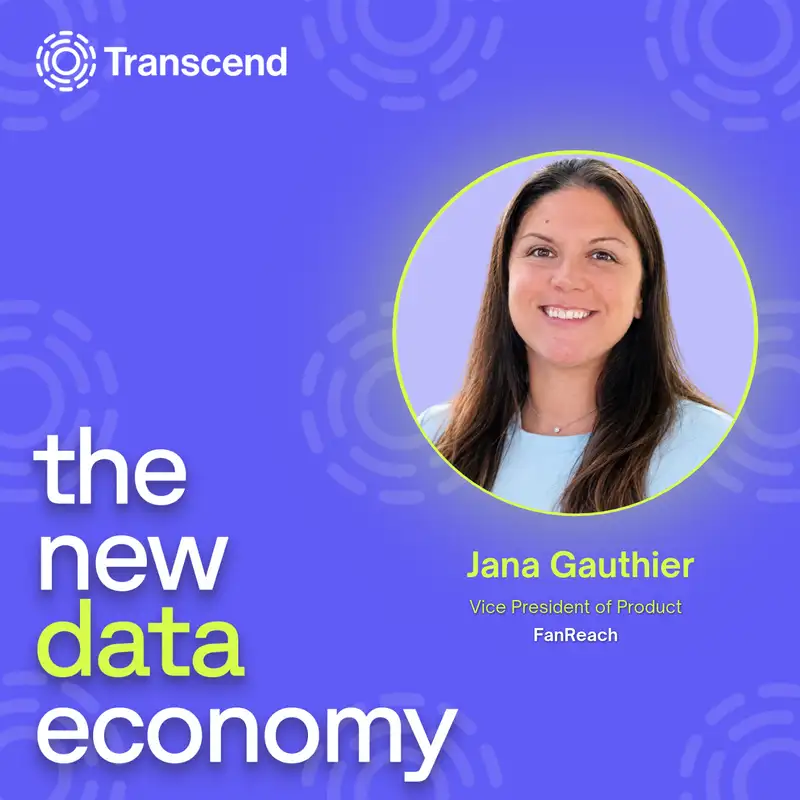
Kate Parker: Hello and welcome.
We're excited to have another
wonderful guest on our show.
We are so excited to welcome an
accomplished digital innovation
pioneer, a sports technology
expert, and mentor to the show.
She has spent nearly two decades
transforming digital experiences
for iconic brands, including the
New England Patriots, New England
Revolution, and Gillette Stadium,
helping generate billions of impressions
and drive significant revenue growth.
Her expertise spans product strategy,
mobile applications, e-commerce,
digital marketing, CRM, data
analytics, and artificial intelligence.
She also served on the NFL Club Digital
Advisory Board from 2011 to 2023.
She was named a 2015 40 Under
40 Brand Marketers honoree and
was inducted into the Salem High
School Athletic Hall of Fame.
She is currently vice president
of product at FanReach.
Jana Guthrie, welcome to the show
Jana Gauthier: Hi.
I'm happy to be here
Kate Parker: We are so excited
to have you on the show.
You have had such an incredible career.
We're gonna get into all of the different
ways that you've really brought product
and data to life in the sports field.
But I'd love to start with
just understanding how data
and digital transformation is
transforming your industry.
Tell me a little bit more about
what you're seeing over in the
athletic side of the world with data.
Jana Gauthier: So I, I think the biggest
transformation right now is that, I
mean, the last decade, two decades, the
focus has really been around collecting
data from a multitude of sources.
And because of that, so much of the
data lives in different silos, and
the game-changing technology now
is, okay, now that we have all this
data, how do we activate against it?
How do we aggre- aggregate it?
How do we orchestrate it?
Um, and with new technology such as AI, I
think the speed to getting logic to market
around how to use the data, not just
collect the data, to use the data, is what
we're gonna see, uh, rapidly transforming,
especially in, in marketing efforts.
And in my industry, which happens
to be live sports and live
entertainment, using, using data
to drive things like engagement,
revenue, sponsorship, et cetera
Kate Parker: When you think of the,
the changes that are occurring and the
phrase the new data economy, we obviously
use that a lot, it's the name of our
podcast, what does that mean for you?
What are you seeing that you
think is somewhat new in the way
that companies are using data?
Jana Gauthier: I would say i-i-in
pro sports, I'm not sure about
the other industries, um, but
it's using data to connect to fans
one-to-one, so actually personalized.
Um, I work for a mobile app platform,
uh, for pro sports teams and venues,
et cetera, and because it's a mobile
application, uh, we're a- actually
able to identify the person against
the device and then assign, uh, a
ton of user attributes in a user
model to the, a particular person.
Um, so in, you know, this game-changing
technology data economy, now individual
fans are more valuable, and these
brands can deliver one-to-one messaging.
Um, I know you, Kate, have
tickets to a particular game.
I know you don't yet have parking.
I know you're bringing your kids.
And when you open up that mobile app
experience, I can talk to you directly.
I can say, "Hey, Kate, um, notice
you didn't get your parking yet.
Here's an offer for 10% off."
I might know you have kids.
"Hey, here's 10% off in the, for a dis-
you know, a discount for buying them a
jersey or a hot dog." Um, and really being
able to deliver relevant, personalized
experiences to specific individuals.
I think that's what we're gonna see
start happening more and more with when
I was talking about, all right, we're
collecting data, now how do we use it?
How do we use it in a literal,
literal one-to-one manner?
Kate Parker: That one-to-one
personalization, even the example
you're giving, you know, it's, it's no
longer these large cohorts of folks.
It's a specific revenue maximizing
strategy and, um, obviously experience
driving strategy on a personal level.
When you're talking to the
board of directors, how are you
connecting the data strategy?
Are you walking them through what
you just walked us through in terms
of that personalization and the
way that you can connect individual
data to a revenue strategy?
Jana Gauthier: Yeah, I'd say, um, the
way we look at it is customer journey
mapping with different goals and outcomes,
and those goals and outcomes may have
to do with driving, uh, visibility
or engagement to a certain feature.
Um, and or it could mean
something around utility, right?
So an operations group is discovering that
there's a bottleneck at a gate, right?
How can you use data, um, and these
devices to change those consumers', you
know, journey by coming to your venue?
Um, so you've got engagement,
you've got utility, and then
you have that commerce piece.
Um, so once you get your fandom in your
environment, whether it be in person
or, or digitally, how can you keep
them, um, in- within your brand and,
and purchasing more and more and more?
Um, so I think when we go to a board,
it's, you know, it's really understanding
do you have one or two goals in
each of these types of disciplines?
Um, and what are proven strategies,
um, that will drive that engagement,
that utility or, or that revenue?
And those are kind of the three
buckets that we look at, um, in
pro sports and live events and,
and venue type of management.
I hope that answered your
question.
Kate Parker: It did.
Yeah.
It's so interesting to think about.
A- and maybe you can connect for
our listeners where you're finding
that value in the tech stack.
Are you finding that, um, sometimes
it's the data being pulled from the
venues where it sort of gets, you
know, gummed up or stuck a little bit?
Or is it moving from
certain data warehouses?
Where are you finding that the data
can add the most value, but might also
be getting the most stuck historically
without a really smart data strategy
utilization structure in place?
Jana Gauthier: exactly what
you're describing has been
the historical problem.
So there is in this data collection
last, you know, 10 years, there's so
much data that lives in different silos.
You've got data in a CRM, you've got data
in a different feature provider, right?
Like, so your ticketing service,
your pro shop, your e-commerce store.
You have all this data about all these
different fans in different sources,
and it takes a lot of historical manual
work to extract it, to analyze it, to
decide how you're gonna target different
peoples based on what they're doing in
those data sets to then get them to,
again, engage, utilize, or create revenue.
Now, um, a platform like the company I
work for is able to start aggregating
disparate siloed data sources.
Um, we're sort of-- I don't want to say
we're middleware, but we can aggregate
all that data from different sources
that are executing out of a mobile
application, um, connect all the dots
to drive those very specific outcomes.
Um, I think our platform is novel, and
I, I think many more companies are gonna
start moving in this direction where
you don't actually have to replace, you
know, different technology providers,
um, because then you're in this infinite
cycle of continuing to have all of
this fractured data in many systems.
It's, you know, solutions like ours and
others that are come out there, it's
like, well, how do we use all the data
we have to get it, um, into an actionable
format that's consistent and similar?
Um, when we talk about AI being
able to read that data from multiple
sources to make sense of it, to
then drive the customer journey.
Kate Parker: It, it's fascinating to
me because the fragmentation piece
is something that we see as well from
a, from a completely different side
of the vantage point, which is the
fragmentation exists and then nobody
knows if they can use it or not.
Do they have the right permissions?
Are they, you know, is this okay
from a regulatory perspective?
Can I use this data?
And what I'm finding, and it sounds
like you're seeing it as well, is with
AI, there's so much more interest in
pulling these disparate data sources
together because now the, the value
is a little bit clearer to people.
If I can connect this entire ecosystem, I
can actually deliver a better experience.
That is super interesting to me, and I,
I would love for you to wind back the
clock for us maybe in the past 24 months.
Like, when did you start to see this
change, and what do you think the biggest
change has been in terms of people's
use of data within organizations that
you serve or it might be your customers?
Jana Gauthier: Well, I can say that
from my company and our perspective,
we've been really showcasing How
easy it is to execute on data once
you have that aggregation done.
Um, so it, for us it's more,
more show and tell, right?
Bringing small examples, we call them
plays 'cause we're in pro sports.
But like, bringing clients really
small examples that it's like, "Hey,
we know of your season ticket members
in your mobile application because
they've signed in to use those tickets.
We know they have an invoice
due," just as one example.
Why don't when they open the
application, you remind them to pay
their invoice or, um, remind them that
they have tickets to the next game?
And just little, little plays
to show them the power of that
one-to-one personalization.
Um, I think it's like that, uh, that
avalanche or that snowball model
where, you know, we're showing and
telling little bits, little bits, and
then all of a sudden the light bulb
is gonna go off, um, and people are
gonna lean in and, and you're, we'll
start seeing more and more of it.
That said, I raised my hand when you were
talking 'cause you, you made me think of
another problem that has not gone away
with data and silos and fragmentation.
Um, resources and where that
data sits and who owns it.
B- you know, you also mentioned
compliancy, what can I actually use?
Um, it's getting different resource
groups across an organization who might
be responsible for small pieces of
the puzzle, different features, right?
So in pro sports, you have a ticketing
group, people that are responsible
for, um, selling tickets to that,
to that event or to that venue.
You have a different group that's
responsible for selling merchandise.
You have a completely different
group that's responsible for
getting fans into the door, and then
once they're in the door, it's a
different group that's selling them
their slice of pizza or their beer.
So sh- technology can solve for
aggregating and orchestrating that
data, but then you do also have
to think about, well, who owns
that customer journey then, right?
If you have different, uh, organiz- you
know, departments within an organization
wanting to drive very specific outcomes
for their piece of the business, and
not necessarily against the whole.
Um, so when you mention talking to boards
of directors or, or up that chain, um,
part of those little plays that you're
making are to showcase, you know, the
power as well as enabling, um, that
data use ac- across all the groups.
Because for me, like, um, in pro
sports, some of that information
around a fan buying pizza all the time
or hot dogs or, you know, a, a kids
jersey, a, a baby's onesie, right?
For that brand- That signals
to the marketing group, right?
Beyond just the pro shop,
beyond just the concessions.
"Hey, this, this individual might
just have a family, so why don't
we from the ticketing group start
marketing them family packs," right?
Discounts so that they could buy a
pa- you know, a set of four tickets
because we think they have a family.
So that's all part of that strategy,
um, as you're thinking through how
to aggregate, orchestrate, and then
convince different people, resources
in an organization, like why their
data matters against the whole.
Kate Parker: Mm-hmm.
You've had some really interesting
success stories that you've shared
with me on the pro sports side.
So the enterprise level, you know,
these big leagues trying to pull
all this data together in silo.
Talk to us a little bit about, um, some
of those recent initiatives, some problems
that you've been able to solve at scale
for some of these really large, um,
companies that are helping to navigate
all of these different vendors and all
of these different platforms together.
Jana Gauthier: Um, well one of the
bigger initiatives we've rolled
out, not only is it tied to data and
one-to-one communication, but it also
has to do with something we call a
signal, um, which is in real time there
are lots of analytics events that are
happening with that consumer, um, in
a branded mobile application, right?
For any of, any of the big leagues
or the, or the brands themselves.
Um, and within a, a mobile application,
as the user's tapping on things, for
example, right, those are signals.
They open up the app, they
might see a preference center.
I'm interested in press
conferences or post-game analysis
or live radio programming.
Um, as the cl- the consumers are
engaging with, with the app and tapping
on those things, those are ultimately
sending signals as analytics events
into the system, which becomes more
rich data that also gets tied back
to an individual fan, for example.
Um, and then you could
use that in real time.
That's the game changer.
Rather than having, you know, to do a
bunch of data work to have those user
attribute models, instead, in real time,
those signals, um, can be effectuating
that customer experience as well.
Um, so again, back to that example
where I mentioned a fan sees, "I'm
interested in press conferences."
Well, as they're tapping on that, right
underneath them, automatically in real
time, their content is transforming
to a filtered view of just press
conferences for them, as one example.
Or they go to a roster screen and they're
interested in, uh, seeing, I'm gonna
use Tom Brady even though he's retired,
because I worked with the Patriots.
But you know, the fan is like,
"Oh my goodness, I love Tom
Brady." They tap on that.
In real time, in that moment, the app can
transform and present them things that are
relevant to that player, as an example.
And when we're talking about scale
for enterprise, the ability and the
immediacy of transforming an experience
based on a real-time signal, um, to
effectuate that customer's journey, um,
is a really big deal and a really big
shift, uh, that I foresee happening, um,
in our industry, but just in general.
Like even if you think about,
uh, the likes of Netflix, right?
Apple TV.
Uh, recommendations, always
pitching you the next thing, right?
Because you watched this show, I
think you're gonna love this show.
Um, taking that same concept, um,
down into pro sports, and it exists
a little bit right now, but in that
more fractured manner, I think.
Um, so I hope that answered your
question, too.
Kate Parker: It did.
Yeah, it makes a ton of sense.
I mean, the, the sports industry is
such a fascinating place for this to
take hold first and foremost because you
do have both the in-person experience,
the digital experience, you're blending
all of these different vendors and
ecosystems and groups together, and
then you also have this interesting fan
dynamic that might have different color.
It might be, you know,
very player specific.
It could be team specific.
It could be region specific.
And so being able to kind of dabble into
that and create that really personalized
experience makes a ton of sense.
Jana Gauthier: I, I would add, for you
that one-to-one we were talking about
early in the call, um, transforming
an app based on that fan's geography
is happening automatically too.
So for example, yeah, and from a marketing
perspective, that's really important too.
So when you open the app, Kate, and
you're a New England Patriots fan,
and you live in California, you
know, am I really gonna be wanting to
pushing, to push ticket offers at you?
Probably not, right?
So when you open that app, I should know
that about you, and instead of pushing
buy tickets to this game, I'm gonna remind
you where to stream the game, where to
get a subscription to stream the game.
Maybe I'm gonna surface to you buying
merchandise over ticket sales, because
ticket sales aren't that relevant to
you because you're not located there.
Um, that's all the strategic thinking
that I think with all of this new data
that's available, or I shouldn't say
it's new, but aggregating this level
of data, um, is what's really gonna
change, um, change the game for all
kinds of leagues, clubs, uh, venues
Kate Parker: Yeah.
The fragmentation piece is also, it's
so visual to think about in the sports
world because, and you walked us through
a couple examples, where it's like you've
got someone selling hot dogs and popcorn.
You've-- And their, you know, their
data's coming in, it says something
totally different than the parking
vendors to the, you know, the
folks manning the ticket booths.
And you can really envision all of
these different points of different data
collection happening, and then the fact
that you can't pull them all together.
What I love about that is that I feel
like every Fortune 500 company has
their own example of that, but it's
just not as visually compelling as,
like, the person selling hot dogs versus
the person manning the parking booth.
But it's such a relevant pattern
for every company to think about
of all of these different silos and
connection points that exist, and what's
possible for the customer and for the
consumer when you bring them together.
Jana Gauthier: one one other thing
you reminded me of that I think
is interesting more broadly is,
especially in the mobile space, the
intention of, um, a mobile application.
Like, what, what is it for?
And I would say the last 10, 15, 20
years, mobile apps were looked at like
an extension of a website, just a place
where a fan or a consumer can connect
to a brand and see some content, read
an article, read a press release, about
us, and, and really looked at as a
secondary nice to have thing, right?
It's just brand affinity, and
I think all companies might
think of it that way still.
Um, but with data and the evolution
of technology and mobile applications,
rather than looking at mobile as this
afterthought, it, it, with all of this
one-to-one opportunity, like, it should
be maybe your number one marketing
opportunity, um, especially around the
data you can collect, um, the data you
can tie to a device, and then ultimately
the, the one-to-one messaging and
connection you can have to that person.
And again, it doesn't have to
just apply to sports in that case.
You know- Right … if you're, if
you're Volvo, the, the car, um, all
right, the utility within that mobile
application is that I can start my car.
Um, and, you know, five years ago it
was probably, oh, you can get your user
handbook in this app, and that's it.
But it's like, well, well, it
could be more than that, right?
Volvo, you know who I am.
You have information on my car.
Like, notify me when I'm
due for my oil change.
Notify me if my tire pressure's low.
When I open that app, maybe give me a
personalized promotion, um, to try to
get me to trade in my car and upsell.
Like, use that mobile device, um, to,
to drive that customer experience or
get me to spend more or do more with you
because I would argue if you're, if we
peel back out of mobile applications,
I'm not gonna get that from a website.
Like, I have to intentionally go
to volvo.com because I think, "Oh,
I need a service appointment."
I have to go there.
That website's not gonna
know me and send me messages.
Sure, an email program could, but if,
if you the brand can connect me into a
phone and keep me on that deck, there's
a l- there's a lot you can do to extend
that relationship, and that goes, a-
again, outside of just pro sports.
Kate Parker: It's great.
Yeah.
What are you seeing are the biggest
challenges on the flip side?
I mean, I feel like we spent so much good
time talking about the value proposition.
It's so clear to me that there is this
missing value orientation for companies
to pull together fractured data, to be
really purposeful about what they wanna do
with it, and then to be able to activate
it effectively to drive that deepening
of value and customization and revenue.
Tell me what you're seeing on the
flip side, where companies might
be stumbling the most or having
the biggest data challenges as it
relates to getting many of these
AI-fueled initiatives off the ground.
Jana Gauthier: I sort of hinted at it
earlier, but I think the biggest challenge
is in resourcing, um, and having staff
or members of an organization that are
really savvy in not only how to collect
the data, but how to use the data.
And then on top of that, how do you use AI
to help them activate that data at scale?
I think, you know, AI
is changing every week.
It's getting better.
There are new tools popping up that do
different things, and I think people,
humans, are trying to keep up with that.
Um, and I don't know if… I mean,
some people have solved for it, but if
we're talking about a lot of brands and
we're talking of in my industry, like
are there total experts who are just
comfortable using these new tools or
using this new data to drive outcomes?
Maybe not yet.
Um, and then in pro sports, I don't
know if this is like this in other
industries, but there's a ton of turnover.
Um, you get, honestly, you get a
lot of young, new folks coming into,
into an industry that are responsible
for executing marketing campaigns.
Um, they're learning those tools.
They're getting their reps in
a season, and then they're kind
of moving on, whether they get
promoted internally, whether they
move to a different department.
We see in pro sports a lot of, um, t-
like folks moving to different teams,
different leagues or the league.
Um, so being able to sustain marketing
campaigns or data efforts, like
consistently and concurrently and, and for
a long duration, I think, um, is something
that every brand really struggles with.
Um, so it's more of a human, a little
bit of a human issue, uh, than a
technology or even a data issue.
Kate Parker: Yeah, that makes sense.
Not having that continuity of folks to be
able to see through some of these fairly
complex initiative that take a lot of,
um, you have to have a lot of internal
knowledge as to what's happening and
have that historical database that you
can kind of pull on to make sure that
your initiative is being thought through.
It's interesting to think
about how all of those moves.
We're certainly seeing, you know, in
the technology sector, we're seeing just
folks moving every which way every 10
seconds, and it does make you wonder how
is a company really going to get up and
going on some of their most important
initiatives with just such high turnover.
So that makes a ton of sense.
Um, let's talk a little bit more
about some of those challenges from,
um, an enforcement perspective and
a data decisioning perspective.
In the sports industry, as you think
about the data use and pulling it all
together, where are the folks who are m-
might be working on policy or enforcement?
Like, are they, are they at the table
yet with the, with the technology?
You obviously sit on the
product side of the house.
Do you find you have all the
right stakeholders sitting
there, um, irregardless of if
they're moving jobs too much?
But, like, do you have all the
right people around the table yet?
Jana Gauthier: I would say
for the most part, yes.
Um, leagues in particular have
been driving a lot of data privacy
and compliancy sort of top-down.
Um, and I can say, you know,
everybody takes that really seriously.
I think international law came
out first, I don't know, five,
six years ago, maybe longer.
I lose track of time these days.
But, you know, at least the last, um,
half a dozen years, there's been a
really strong effort to lock down, um,
you know, what is confidential data,
what is PII, um, blocking PCI to,
you know, reduce risk for consumers.
Um, all that's great, and I think, you
know, from a technology side, mobile
applications, um, are, are putting in a
ton of le- levers over the last few years
to enable, um, in my case, fans, uh, on
our, uh, on our app platform, you know,
rights very granularly to, like, allow
this SDK to do this, allow, allow this.
Just similar to cookies
on a website, right?
You know, I, you know, allow this, uh,
ticketing platform in this application
because I need it to get my ticket.
Um, do not allow some type of sweepstakes.
Um, so all those levers are,
are be- being put into place.
Um, and I, I look at it as a good
thing, not a restriction, right?
Um, because just like everything in
life, you know, you gotta give the
individual their own sense of control.
Um, and, you know, do I want, you know,
w- and then it comes to the question
for the organization, by the way,
for, from the goal mapping, right?
Me as a fan, do I want to give you
information because you're gonna
make my experience better, right?
The more I trust you, the brand, the
organization, again, not even pro sports,
the more I trust you, the more information
I'm going to give you to then have that
one-to-one relationship with me, um, so
that you can tell me when my car service
is, or you can tell me that you're gonna
offer me this discount because you're
so proud to have me as a fan, and my
tenure is amazing, and you love me.
Like, that makes me feel good,
and I'm probably gonna give you
more of that data or allow you to
access that, more of that data.
Um, and you know, again, without some of
these features, if you're, you know, an
organization that's not controlled, and
you're blasting everyone everything all of
the time with zero strategy, that's when
people, you know, are gonna tune you out.
Um, you know, again, it's not
just mobile apps, mobile web,
it's marketing in general, right?
How do you, how do you decrease noise?
Um, and I would argue a lot of the
compliancy, the privacy, all these
regulations coming in around data is
helping to reduce noise and allowing
brands and organizations to be much
more strategic, um, in how they're
gonna connect and market to the fans.
Kate Parker: Yeah.
It cr- it definitely creates that fit
for purpose relationship where there's
something where folks are saying, "Yes,
I'm gonna give you this data. I'm gonna,
I'm gonna let you have these permissions,
and then I'm gonna expect that the
experience back I'm getting is gonna be
something that feels really good to me."
And I think, I think you're right.
I think consumers are excellent
at figuring out what feels a step
too far and what feels conversely
like a magical experience.
Like, yes, I did… You
know, I am a Patriots fan.
I do live in California.
I do- don't want ticket sales 'cause
I can't get to the… Like, that to
me would be a very magical experience,
something that's personalized for me.
Um, but you can also see where it goes
wrong, and I think the brands that get
it right are very, very thoughtful about
the relationship they wanna have with
their customer, and they view data as
a means to fueling that relationship.
In the same way you would, you know, just
with a friend or, you know, with another
human, how much, how much information am
I gonna bring into this conversation in
order to make it feel rich and meaningful
and purposeful and not a step too
Jana Gauthier: Yeah.
What, back in my day at the Patriots,
whenever we were starting a new
initiative, a new marketing campaign,
a new program for fans, the question
that we would always pause and ask
ourselves was, um, does this add value?
Does this, does this thing
add value to the, to the fan?
If yes, okay, now we plan, now
we strategize, now we workshop.
If the answer is no, like,
we actual- full stop.
We're not gonna, we're not gonna invest,
we're not gonna pursue this thing.
It's not worth it.
Um, so yeah, so I fully agree with that.
You know, who is, you know, who
is… Don't forget these are people.
The data is people.
Does, and what you're, is what you're
trying to do add value to their life?
Kate Parker: It's so true.
Yeah.
Well, I love what you gave us
in terms of thinking about the
fragmentation and pulling it together.
I have to say, out of all of our
episodes, I think it's the most visual.
I think it will really stick with people
of like, oh, yes, like there's all that
data out there in all of these different
ways, and you can pull it together and
it can be something really meaningful.
I understand you got into this field
through a new media class that you took.
Talk to us a little bit about how you got
into data usage, how you got into product.
I mean, you sit at such an interesting
intersection between product and data
and marketing, and I'd love to understand
how you found yourself in this field.
Jana Gauthier: Yeah, so my, my
journey is actually gonna probably
date me in, in technology.
Um, when I went to college, I
went to school to study, uh,
television production specifically.
Um, and I got into those classes,
and I was editing and, and using
cameras, and I started feeling bored
because I had a ton of friends and
classmates that were taking film.
They were taking audio production.
They were taking compu- 3D animation and
photography and all these really cool
disciplines that were media at the time.
And I went to a counselor and was
like, "Uh, what else can I do here?"
And he's like, "Well, there's this
new thing, like, that's digital.
It's a cl- it's a, it's new media,
so you can explore everything.
Everything from a creative
m-marketing perspective, that
stuff that doesn't even exist yet.
Um, why don't we take you in this
path?" I did that with the intention
then of leaving school and getting,
uh, a job at, um, what was called at
the time interactive marketing agency.
So that had a lot to do
with building websites.
So I took that internship, and I came
up in a time where, uh, companies had
closets filled with computer hardware,
servers, wires, internet cords.
And that hardware in a s- in a facility,
there was no hosting in the cloud.
Like, we were managing websites
for world-known brands in, in data
centers and in closets, right?
Um, so that's where I first started
getting exposed to what is now
digital or just technology, uh,
building websites out of closets.
And over time, I'm so fortunate that,
um, early on, I ended up moving…
I got a s- job with the Patriots
being a technical project manager.
I started working with vendors in the
technology space, mostly on websites.
I also come up, came up in a time
where there wasn't even online
shopping, believe it or not.
There were not, I… There
weren't even smartphones, right?
There was just still,
like, push button phones.
Um, so being at a brand like the Patriots-
w- which had an amazing ownership group
that wanted to innovate and be first
to market, like, I was enabled that
opportunity as a technical project
person to, like, find new digital product
and figure out, okay, how do we get
the Patriots onto this thing, right?
So my journey went from
websites to e-commerce.
Social media popped up.
I think the Patriots, I… Fun fact about
me, South by Southwest in 2007, or it
was 2006 or 2007, I went to the Twitter
launch party at South by Southwest,
came back from that conference and
lit up, uh, at the time it was called
Real Patriots, and we launched that
with the, uh, NFL Draft that year.
So the first Patriots tweets were, um,
were about the draft picks for that year.
Um, but so innovating every
single bit of new technology, I
was afforded that opportunity.
Um, after social media, respon- like
mobile web existed before responsive web.
There was a time where you had to
maintain two different websites, one
for a desktop, one for a mobile phone.
Then again, that became responsive,
and then you get the mobile
applications, uh, podcasting.
So I've just, I've had a heck
of a great time over the last 20
years, um, getting the opportunity
to really explore new tech.
Um, and I would say in my current
role when you guys asked me to come
on and, and do this podcast, as you
can see, I get excited because now,
like, my next new thing is, is data.
Like, we've already figured
out how to collect it.
How do we use it?
And now leaning into AI, right?
I don't think anyone really knows where
the AI stuff is all gonna really land.
Um, so being able to be a part of,
of figuring out those strategies
for me right now is just another
part of that, just cool pioneering
different bits of tech along the
Kate Parker: Yeah.
I love that because it feels like you,
you joined the new media class and
then you never really left, right?
You've been doing new- You're still,
you're in the new media class still.
That's amazing.
Just at the, continually at the forefront.
I mentioned in your intro that you were
in your high school's sports hall of
fame, and it obviously is not random.
You work in the sports industry,
but as I understand it, you also
do quite a bit of mentorship.
Can you just tell a little bit to our
listeners about how you have blended
this personal passion of yours into
your work experience and what you think
it has brought to you as a leader in
particular?
Jana Gauthier: Sure.
Um, yeah, so I played competitive
soccer and softball, uh, my entire life.
I was fortunate to play in college too.
Fortunate to travel, uh, a little bit
in Europe playing those sports as well.
Um, got into the Hall of Fame, and I
actually currently t- I have a game today.
I currently am coaching, uh, high
school varsity soccer for my local town,
who my daughter plays on that team.
Um, but as part of that, my whole
philosophy in leadership and life is
around the importance of a team, and
recognizing that every single individual
you encounter in your life, whether it be
your core staff, your organization at a
whole, organizations you work with, every
single person is a piece of that puzzle.
Every single person has some type
of value that they can add to a
group, and you as a leader need to
recognize, like, w- what you bring.
Like Kate, what, what do
you bring into a group?
Maybe you're more vocal or quick-witted
and have ideas fast and furiously.
Someone like me, maybe I'm
more q- quiet and processed.
Um, and starting to pull
together these teams that really
balance strength and weaknesses.
When I took on high school coaching a
few years ago, um, I actually came into
a culture, and I think this translates
into the workplace too, but I stepped
into a culture where girls were competing
against each other on the same team, uh,
for starting spots and starting positions.
So during the first tryout I
attended, it was like these two
girls were fighting every single day.
Who was gonna be the center back?
Um, who, you know, who was
gonna be the right back?
Who's our main striker?
Um, and as a coach, I came into
the program with my other coach,
I'm like, "None of you actually
own any of these positions.
All of you on any given day are gonna
perform better than or less than, and we
need to figure out collectively, like,
where everyone fits the best today.
Not tomorrow, not next week, but
today, how are we gonna accomplish
these goals?" Um, and then I take that
right into the workforce too, right?
So I lead a group of, um, people
that work with, uh, clients.
I work with our engineers directly.
I work with, um, some junior level,
uh, programmers and, and a lot of what
I do every day is recognizing, like,
who does what, who does what well,
where do we shuffle things around
to meet today's objective, right?
Um- And yeah, and I think, and I think
growing up though, to your other part
of the question, you know, growing
up playing competitive sports, like
you get a little bit more resilience,
you get a little bit more grit, um,
and you can be, I think, a little bit
more flexible in the long term because
playing pro sports, you don't always win.
You're not always gonna win, right?
There's gonna be failures, and
then figuring out how to not
dwell in those failures and use
those as learning opportunities.
I'm saying tons of cliche things
right now, um, but it all really,
really matters, um, to like, to, to
just generally optimize, optimize
your life, optimize your career,
optimize your team, optimize your
output, the work you're putting in.
Um, so I'm super passionate
obviously about teamwork
Kate Parker: I love it because when I
asked you earlier what you thought the
biggest challenge was for companies
in realizing their AI initiatives,
you talked us through how, you know,
there was just so much movement in
the personnel piece that it felt like
it was a barrier for enterprises to
really get these huge initiatives that,
you know, obviously the boards care
deeply, the stock market cares deeply,
everyone's trying to get this done.
And it is so powerful to hear your
viewpoint on personnel from a team
perspective, because you can really
extrapolate and think about how
corporations need to use that as well.
And because there's one
goal right now, right?
Which is to launch AI, and you've
got, you've got a team of people who
might be in and out and, you know,
less capable, more capable, and
you've just gotta figure out how to
get it done based on what you have.
And it feels like such a, a
great analogy for what our
corporations are facing as well.
Jana Gauthier: And I'd say too, to
like people at these big corporations
that do have a lot of turnover,
it's even like h- how do you get
people to wanna stick around, right?
Like seeing, um, your staff as,
as people that have needs and
have value and recognizing that.
I think, you know, all my time in
different, um, you know, working with
different groups and technology partners,
like I think people need not only to be,
uh, criticized sometimes or like spoken
to when things aren't going so great.
I think it's equally important
to celebrate wins, um, celebrate
successes, be very clear in the
value that they're, they're adding.
So I keep bringing up value adding
bra- value added to, you know,
consumers, value added to fans, but
also value added to, to your people
that you're working with every day.
Right.
Like letting them know
where they're adding value.
Why, in the role they have
today, like why does that matter?
Same thing I take down to the soccer team.
Like there's some girls that do sit on
the bench all of the time and they, they
get upset, so it's reminding them once in
a while, "Hey, we, we might call on you.
Like you are an impor- important piece.
Like if you're not on this bench and
someone goes down, like we're in big
trouble without you and that's value
that you're adding to the team."
So same thing in the workplace.
Kate Parker: It's so true.
I love that.
Well, I think we've had such a
great conversation about value.
It's been such a awesome peek into
the sports industry and hearing
about your data value realization
work that you've been doing, and
all of the success that you've had.
So I wanna thank you, first and
foremost, for being on our podcast.
It's been so wonderful having you here.
Jana Gauthier: Thank you
so much for having me.
This was really fun.
Kate Parker: I wanna thank our audience.
Hopefully you've learned something
really interesting about an industry,
um, that perhaps is new to you, and
thinking about how you can apply
it to your corporation as well.
Um, and I wanna thank everyone for joining
us on the New Data Economy Podcast.
This has been another exciting episode,
and we were so thankful to have you on.
So
Thank you
again